
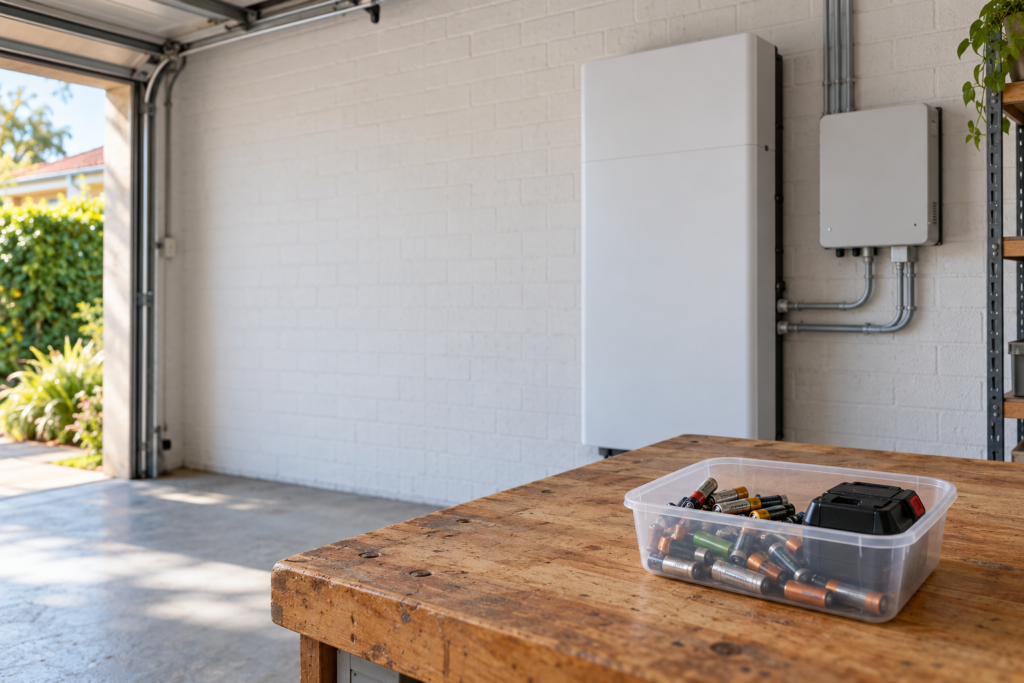
Whether you can use a lithium battery drop-off depends entirely on the size of the battery. Loose household cells, power tool packs and e-bike batteries can go to a drop-off point, and there’s a national network of them. A home battery or solar energy storage system can’t — it’s too heavy to hand over at a counter, it holds residual charge, and it’s classified as dangerous goods for transport. Those batteries are collected from your site instead.
LFP Recovery Australia is a specialist collection and recovery service for end-of-life LFP and NMC batteries, operating across Australian capital city CBDs. This page explains which category your battery falls into, and what happens in each case.
Is There a Lithium Battery Drop-Off Near Me?
Yes, for small batteries. Australia has a national product stewardship scheme for loose and small-format batteries, with drop-off points in supermarkets, hardware stores, office supply retailers and council facilities across every state.
The B-cycle battery stewardship scheme lists participating drop-off locations. If what you have is any of the following, that’s your answer and you don’t need us:
- AA, AAA, C, D and 9V batteries, rechargeable or single-use
- Button and coin cells
- Mobile phone, laptop and tablet batteries
- Power tool battery packs
- E-bike and e-scooter batteries
- Camera, torch and small appliance batteries
Drop-off is free for these, the bins are usually near the store entrance, and no booking is needed.
What Drop-Off Points Won’t Accept
Every drop-off program in the country caps what it takes by size and format. None of them accept:
- Home energy storage batteries and solar battery systems
- Residential or commercial ESS modules and racks
- EV battery packs or modules
- Any battery that is swollen, leaking, deformed or heat-damaged
- Lead-acid batteries, including car batteries
If your battery is on that list, a drop-off point isn’t a dead end to work around — it’s the wrong service. Here’s why.
Why Won’t Drop-Off Points Take Large Batteries?
Three reasons, and none of them are policy preferences. They’re handling, transport law and physics.
Weight and handling. A home battery is a two-person lift at minimum, often requiring equipment. A retail drop-off bin is a container near a shop entrance, staffed by people whose job isn’t battery handling. There’s nowhere for a wall-mounted storage unit to go in that system.
Transport classification. Lithium batteries are carried as Class 9 dangerous goods under the Australian Dangerous Goods (ADG) Code. Small batteries below certain thresholds are treated differently from large-format packs, which is exactly why the two have different disposal routes. A home battery moved by road is a dangerous goods consignment, not a boot-load.
Residual charge and thermal risk. A retired home battery is rarely at zero charge, and stored energy in a damaged cell is what drives thermal runaway — a self-sustaining chain reaction where a damaged lithium cell heats uncontrollably and can ignite. A large pack knocked, dropped or punctured during an informal handover carries real consequences, which is why handling it is a trained task.
So the answer to “where can I drop this off” is that you don’t. You have it collected.
Which Route Applies to Your Battery
|
What you have |
Route |
Cost |
|
Loose household batteries (AA, AAA, button) |
B-cycle drop-off point |
Free |
|
Power tool, e-bike, phone and laptop batteries |
B-cycle drop-off point |
Free |
|
Home battery / solar storage (LFP or NMC) |
Site collection |
Quoted after assessment |
|
Residential or commercial ESS |
Site collection |
Quoted after assessment |
|
EV battery pack or module |
Site collection |
Quoted after assessment |
|
Swollen or damaged lithium pack |
Site collection — declare it |
Quoted after assessment |
|
Lead-acid, including car batteries |
Auto recycler or scrap metal merchant |
Often paid or free |
We work with lithium chemistries: LFP — lithium iron phosphate, written LiFePO₄ — which is the most widely used chemistry in Australian home solar storage, and NMC — lithium nickel manganese cobalt oxide — which is common in EV packs and some earlier home systems. We don’t handle lead-acid, which has its own established recycling route.
Got a large battery? Submit a collection request with your address and battery details, and our team will assess what’s involved.
Can I Drop Off a Home Battery If I Take It Out Myself?
No, and taking it out yourself isn’t the step to start with.
A home battery is normally connected to an inverter and your switchboard. Disconnecting it is licensed electrical work, not a weekend job — and a battery that’s been disconnected incorrectly can be more hazardous than one left in place.
Even once it’s out, the drop-off problem doesn’t change. The weight, the dangerous goods classification and the residual charge are properties of the battery, not of how it got there. Removing it yourself gets you a heavy Class 9 item in your garage and no legitimate place to take it.
If your battery is damaged in any way, this matters more, not less. Never attempt to open, dismantle, discharge or transport a damaged lithium battery yourself. Declare the damage on the collection request form and include photos — we’re equipped to handle swollen and thermally unstable packs, but only when we know before we arrive.
While a battery waits for collection: keep it disconnected and isolated, away from flammable materials and exits, not covered or stacked, and never in any bin. If a battery is actively smoking, hissing, swelling or hot to the touch, leave the area and call 000.
Questions about whether yours needs an electrician first are covered in our frequently asked questions, along with what to do about damaged packs.
How Do I Get a Battery Collected Instead?
You submit a form, we assess it, and pickup is arranged from your address. The full sequence:
- Collection request — you submit the online form with battery details, photos and site access notes.
- Safe collection — pickup is arranged from your site with trained handlers.
- Transport — compliant transport aligned with the ADG Code, as a Class 9 dangerous goods consignment.
- Cell-level assessment — the pack is dismantled under controlled conditions and every cell tested for voltage, internal resistance and capacity.
- Battery recovery — cells that meet our testing standards are recovered for potential reuse.
- Responsible recycling — cells that fail testing go to approved recycling partners.
Step four is what separates this from a skip bin with extra steps. Cell-level diagnostics means judging each cell on its own measured performance rather than writing off a whole pack on its age or its label — and a pack described as “end of life” routinely contains cells still within reusable specification.
Everything is tracked under a documented chain of custody: a written record of who held the battery at each stage, from pickup to final outcome. Nothing is stockpiled and nothing goes to general waste. Not every cell can be recovered — damage, deep degradation and prior thermal events all rule cells out — and we’ll tell you what actually happened to yours rather than promising an outcome upfront.
The full six-step collection and recovery process has more detail on each stage.
What If I’m Not in a Capital City CBD?
Submit a request anyway. We collect from capital city CBDs across Australia: Sydney, Melbourne, Brisbane, Perth, Adelaide, Hobart, Canberra and Darwin.
Outside a capital city CBD? Submit a collection request and we’ll let you know if we can help — our operations team assesses outer-suburban, regional and remote pickups case-by-case. It costs nothing to ask, and the alternative is a battery sitting in a garage indefinitely.
If you’re in New South Wales, our guide to home battery disposal in Sydney covers the same ground with local detail. Full details of what we accept are on our battery collection service page.
What Does Collection Cost?
Collection is quoted case by case after assessment. The figure depends on battery type and chemistry, condition, whether it’s still installed, site access and transport requirements.
Free disposal genuinely exists — for the loose household and small-format batteries covered by the stewardship scheme above. It doesn’t extend to large-format packs that need a trained handler and dangerous goods transport, and any service claiming otherwise is worth a second look.
Submit the form with photos and site access notes and you’ll get a figure that reflects your actual situation. We respond by email once the battery has been assessed.
FAQ
Loose and small-format lithium batteries — phone, laptop, power tool, e-bike and household cells — can go to a B-cycle drop-off point, free of charge, at participating supermarkets, hardware stores and council facilities. Home batteries, solar storage systems and EV packs are too large for any drop-off point.
No. Home energy storage batteries are excluded from every drop-off program in Australia because of their weight, their residual charge, and their classification as Class 9 dangerous goods for transport. They're collected from your site instead, with trained handlers and compliant transport.
For small batteries, almost certainly — the B-cycle network covers every state through retail and council locations. For a home battery or solar storage system, the question doesn't apply: those are collected from your address rather than dropped off anywhere.
Far far away, behind the word mountains, far from the countries Vokalia and Consonantia, there live the blind texts. Separated they live in Bookmarksgrove right at the coast
Three reasons: a home battery is a multi-person lift that retail staff aren't equipped to handle; lithium batteries move as Class 9 dangerous goods under the ADG Code, with different rules for large packs; and a retired pack holds residual charge, making damage during an informal handover genuinely hazardous.
Submit a collection request with your address, battery details, photos and site access notes. The battery is assessed, pickup is arranged with trained handlers, and transport is compliant with the ADG Code. We respond by email with what's involved and a case-by-case quote.
No. Disconnecting an installed home battery is licensed electrical work, and removing it doesn't change the weight, the dangerous goods classification or the residual charge. You'd end up with a heavy Class 9 item and nowhere legitimate to take it. Never handle a damaged battery yourself.
Arrange Collection Instead
If you came here looking for somewhere to drop a battery off, the short version is: small batteries have a free drop-off network, and large ones get collected from your address. Both are legitimate routes. Only one of them fits a home battery.
Tell us what you’ve got — chemistry if you know it, capacity, approximate age, whether it’s still installed, and whether there’s any visible damage.