
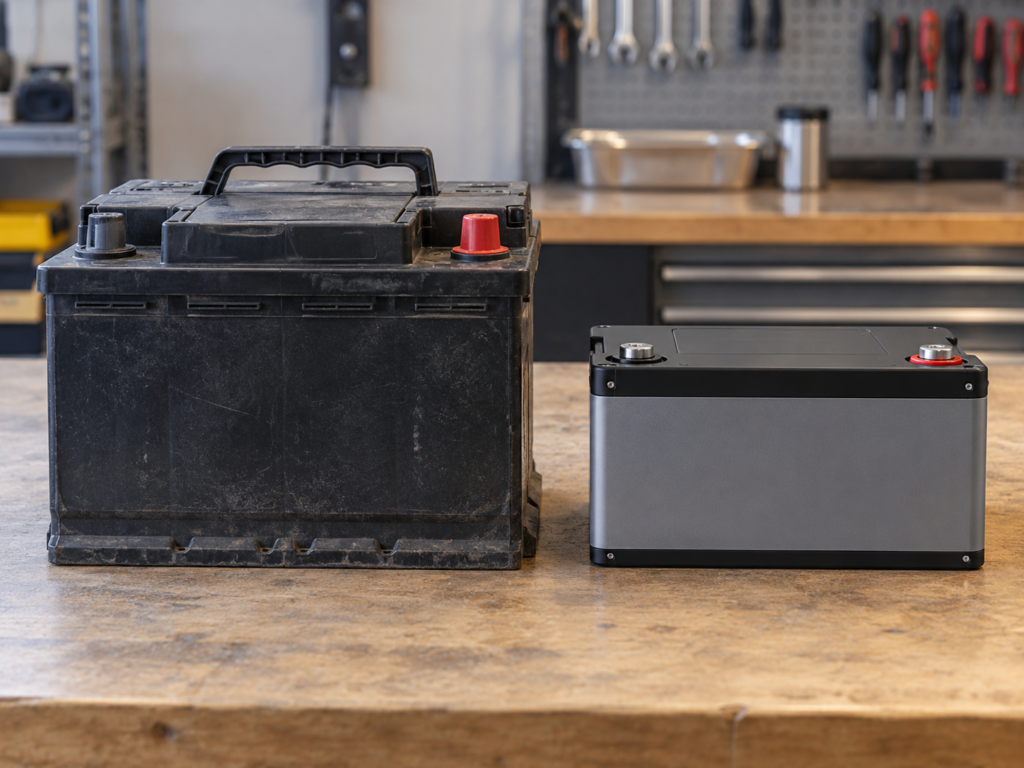
Lead-acid battery disposal and lithium battery collection are two different services, and which one you need depends entirely on the chemistry sitting in front of you. Lead-acid batteries go to auto recyclers, battery retailers and scrap metal merchants, who generally want them. Large-format lithium batteries are collected from your site by a specialist service.
We handle lithium, not lead-acid. LFP Recovery Australia is a specialist collection and recovery service for end-of-life LFP and NMC batteries — home storage, commercial ESS and EV packs — operating across Australian capital city CBDs. If what you have is a car battery, this page will tell you so in about thirty seconds and point you somewhere useful.
The identification matters more than people expect, because the two chemistries look similar in some applications and are handled completely differently.
How Do I Know If My Battery Is Lithium or Lead-Acid?
Start with the label, then the weight, then the terminals. Most batteries declare their chemistry somewhere on the case, and the ones that don’t give it away physically.
Signal | Lead-acid | Lithium |
Label text | “Lead acid”, “Pb”, “AGM”, “Gel”, “Flooded”, “SLA”, “VRLA” | “LiFePO₄”, “LFP”, “Li-ion”, “NMC”, “Lithium” |
Capacity marking | Usually Ah (amp-hours) and CCA (cold cranking amps) | Usually Ah and kWh or Wh |
Weight for the same capacity | Substantially heavier | Substantially lighter |
Terminals | Two lead posts, often with removable caps or vents on top | Usually bolt-down terminals or a sealed connector, no vents |
Case | Hard plastic, often with visible cell divisions or caps | Sealed plastic or metal, often with a display, buttons or status LEDs |
Electronics | None | Often a battery management system — wiring, a circuit board, status indicators |
Where it was installed | Engine bay, under a seat, in a battery box | Wall-mounted, floor-standing on a frame, in a cabinet or rack |
The quickest tell is electronics. Lead-acid batteries are passive — two terminals and chemistry. Lithium batteries in home storage, EVs and most modern deep-cycle applications carry a battery management system, which means wiring, a circuit board, and often a screen or indicator lights. If your battery can tell you its own state of charge, it isn’t lead-acid.
LFP is lithium iron phosphate, written LiFePO₄ — the chemistry most common in Australian home solar storage. NMC is lithium nickel manganese cobalt oxide, common in EV packs and some earlier home systems. Both are lithium, and we collect both.
Where Do I Dispose of a Lead-Acid Battery?
At an auto recycler, a battery retailer or a scrap metal merchant. Lead-acid has a mature recycling route in Australia, and unlike most waste streams, the material has enough value that collectors generally want it.
Where to take it:
- Battery retailers and auto parts stores — many accept old batteries, particularly when you’re buying a replacement
- Auto recyclers and wreckers — routine business for them
- Scrap metal merchants — lead content gives the battery scrap value
- Council waste and transfer stations — most accept lead-acid batteries; check acceptance first
Whichever route you choose, a few things matter. Lead-acid batteries contain sulfuric acid and lead, both hazardous. Keep the battery upright, don’t tip or shake it, don’t open the caps, and don’t leave it anywhere it might be knocked over. If the case is cracked or leaking, say so when you ring ahead — handling changes.
They must never go in a kerbside bin. State environment regulators cover this for every battery chemistry — the <a href=”https://www.epa.nsw.gov.au/Your-environment/Recycling-and-reuse/never-bin-a-battery” rel=”nofollow” target=”_blank”>NSW EPA’s guidance on battery disposal</a> sets out why and what to do instead.
Do You Take Car Batteries?
No. We collect large-format lithium batteries only.
It isn’t a preference — it’s a different operation. Lead-acid recovery is a lead smelting and acid neutralisation process. Lithium recovery is cell-level testing, dismantling and material separation. Different equipment, different handling, different downstream partners.
The good news is that lead-acid is the easier of the two to deal with, and often the cheaper. Where lithium collection is a quoted service, a lead-acid battery is usually accepted free or with some scrap value returned to you.
Is a Deep-Cycle Battery Lithium?
It can be either, and this is where most misidentification happens.
“Deep-cycle” describes what a battery is for — sustained discharge over hours, rather than the short high-current burst a car starter needs — not what it’s made of. Deep-cycle batteries in caravans, boats, camper trailers and off-grid systems come in both chemistries:
- Flooded lead-acid — the traditional type, with removable caps for topping up with distilled water
- AGM (absorbed glass mat) — sealed lead-acid, no maintenance, common in caravans and marine use
- Gel — sealed lead-acid with a gelled electrolyte
- LiFePO₄ (LFP) — lithium, increasingly common in newer caravan, marine and off-grid builds
The first three are lead-acid and go to an auto recycler or scrap merchant. The fourth is lithium.
How to tell with a deep-cycle battery: check the label for “LiFePO₄”, “LFP” or “lithium”. Look for a Bluetooth logo, an app reference, or a display — lithium deep-cycle batteries very often have one and lead-acid never does. Check for caps or vents on top, which indicate flooded lead-acid. And weigh it in your hands: for the same amp-hour rating, the lead-acid version is substantially heavier.
If it’s a LiFePO₄ deep-cycle battery out of a caravan or boat, that’s lithium — and depending on its size, it may be small enough for the free drop-off network rather than a site collection. Our frequently asked questions cover formats and chemistries, or submit a request and we’ll tell you which applies.
Worked out you’ve got a lithium battery? Submit a collection request with the details and we’ll assess what’s involved.
What’s the Difference Between LFP and Lead-Acid?
They share almost nothing beyond storing electricity. The differences that matter for disposal:
Lead-acid | LFP (LiFePO₄) | |
Key materials | Lead, lead dioxide, sulfuric acid | Lithium, iron, phosphate |
Hazard type in transport | Corrosive (Class 8) | Class 9 dangerous goods |
Main handling risk | Acid leakage, lead exposure, weight | Thermal runaway if damaged |
Recycling route | Lead smelting and acid neutralisation | Cell testing, then recovery or material recycling |
Typical disposal cost to you | Free, or paid for scrap value | Quoted service |
Who takes it | Auto recyclers, scrap merchants, retailers | Specialist lithium collection |
Both chemistries are carried as dangerous goods under the <a href=”https://ntc.gov.au/codes-and-guidelines/australian-dangerous-goods-code” rel=”nofollow” target=”_blank”>Australian Dangerous Goods (ADG) Code</a>, in different classes, which is part of why the two streams don’t mix.
The risk profiles are genuinely different. A lead-acid battery’s danger is chemical and physical — acid burns, lead content, and sheer weight. A lithium battery’s danger is thermal runaway: a self-sustaining chain reaction where a damaged cell heats uncontrollably and can ignite. That’s why a cracked lead-acid battery and a swollen lithium pack need different responses, and why no single service handles both well.
What We Collect
Large-format lithium batteries, collected from your site: home energy storage and solar battery systems, residential and commercial ESS, EV packs and modules, and damaged or swollen lithium packs where the damage is declared in advance.
When we collect one, every cell in the pack is tested individually for voltage, internal resistance and capacity. Cells that meet our testing standards may be recovered for potential reuse; cells that fail go to approved recycling partners under a documented chain of custody — a written record of who held the battery at each stage, from pickup to final outcome.
Not every cell can be recovered. Damage, deep degradation and prior thermal events all rule cells out, and we won’t promise reuse for a specific battery before it’s been assessed. What happens to cells that do pass is covered on our battery recovery and repurposing page, and what’s included in collection is on the battery collection service page.
We collect from capital city CBDs across Australia: Sydney, Melbourne, Brisbane, Perth, Adelaide, Hobart, Canberra and Darwin. Outside a capital city CBD? Submit a collection request and we’ll let you know if we can help — our operations team assesses outer-suburban, regional and remote pickups case-by-case.
Loose household batteries, power tool packs, phone and laptop batteries and e-bike batteries aren’t ours either — those go free to a B-cycle drop-off point. More on how we work and what we specialise in is on our about page.
Which Service Do You Need?
- Label says “Pb”, “AGM”, “Gel”, “Flooded”, “SLA” or “VRLA”? Lead-acid. Auto recycler, battery retailer or scrap merchant.
- Came out of an engine bay, with two lead posts and caps on top? Lead-acid. Same answer.
- Label says “LiFePO₄”, “LFP”, “NMC” or “lithium”, with a kWh rating? Lithium. Read on.
- Wall-mounted, floor-standing, or needs two people to lift? Large-format lithium. Site collection.
- Lithium, but small enough to carry in one hand? Free B-cycle drop-off point.
- Deep-cycle from a caravan or boat? Check the label — it could be either.
If you’ve landed on large-format lithium, that’s us.
And if you’ve landed on lead-acid, take it to an auto recycler. You’ll likely be paid for it, and you won’t need us at all.
FAQ
Check the label first — lead-acid says "Pb", "AGM", "Gel", "Flooded", "SLA" or "VRLA", while lithium says "LiFePO₄", "LFP", "Li-ion" or "NMC". Lead-acid is substantially heavier for the same capacity, has lead posts and often vent caps, and carries no electronics or display.
At an auto recycler, battery retailer, scrap metal merchant or council waste facility. Lead-acid has an established recycling route and collectors generally want it because of the lead content. Keep the battery upright in transit, don't open the caps, and ring ahead if the case is cracked or leaking.
No. We collect large-format lithium batteries only — home storage, commercial ESS and EV packs. Car batteries are lead-acid, which requires lead smelting and acid neutralisation rather than cell-level testing. Auto recyclers and scrap merchants handle them, usually free or with scrap value returned.
It can be either. "Deep-cycle" describes the duty cycle, not the chemistry. Flooded, AGM and gel deep-cycle batteries are lead-acid; LiFePO₄ deep-cycle batteries are lithium. Check the label, look for a display or Bluetooth connectivity, and check for vent caps — only lead-acid has them.
LFP is lithium iron phosphate — lithium, iron and phosphate, carried as Class 9 dangerous goods, with thermal runaway as the main handling risk. Lead-acid contains lead and sulfuric acid, is corrosive in transport, and risks acid leakage. They have entirely separate recycling routes.
No. The processes are fundamentally different: lead-acid recycling involves lead smelting and acid neutralisation, while lithium recovery involves cell-level testing, dismantling and material separation. Mixing the streams is unsafe and neither process handles the other chemistry correctly.
Need to Dispose of an Old or End-of-Life Lithium Battery?
Looking for a safe and responsible way to dispose of your old, damaged or end-of-life lithium battery? LFP Recovery Australia provides professional battery collection, assessment, recovery and recycling services for LFP (LiFePO₄) and NMC batteries, including solar battery storage systems, commercial energy storage batteries and electric vehicle (EV) battery packs.
Our team assesses each battery to identify opportunities for recovery and repurposing, while ensuring unsuitable cells are directed to responsible recycling. Whether your battery is damaged, no longer performing or ready for replacement, we’re here to help you take the next step.
Not sure what type of battery you have? Submit a collection request with photos and our team will review your details and advise on the next steps.