
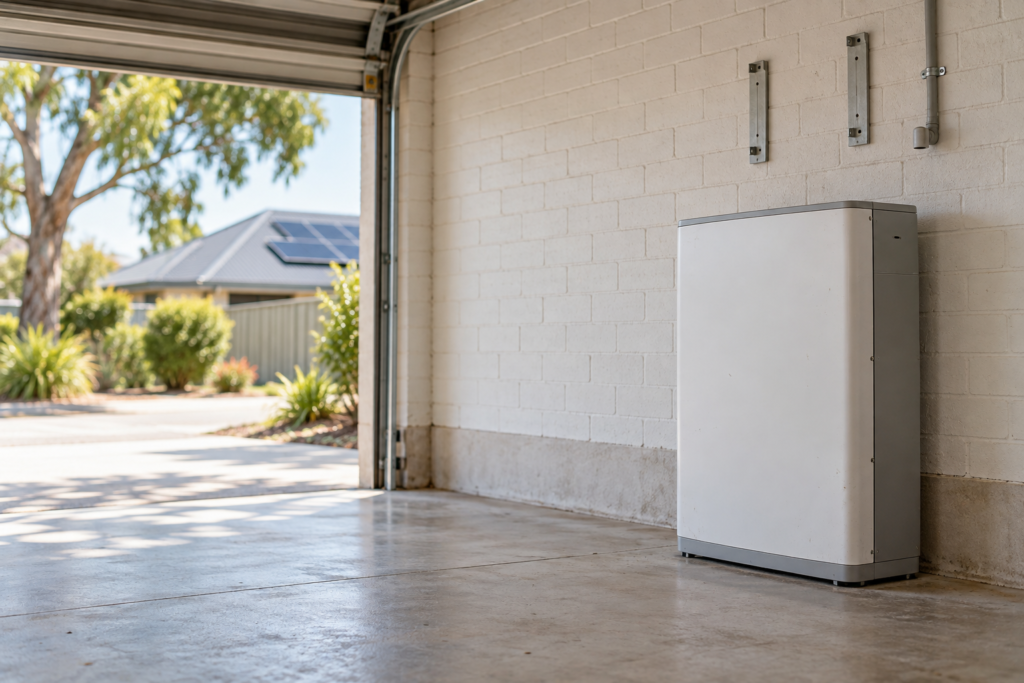
Solar battery disposal in Australia works one way: the battery is collected from your site. A retired solar battery can’t go in a bin, can’t go to landfill, and in almost all cases can’t be driven to a drop-off point — it’s too heavy to handle safely and it’s classified as dangerous goods for transport. LFP Recovery Australia is a specialist collection and recovery service for end-of-life LFP and NMC batteries, operating across Australian capital city CBDs.
If your battery has been replaced during a system upgrade, has stopped holding charge, or is sitting disconnected in the garage while you work out what to do with it, this is what your options actually are.
Can You Put a Solar Battery in the Bin?
No. Lithium batteries must not go in kerbside rubbish or recycling bins anywhere in Australia, and a solar battery is the clearest case of all — it’s large, it holds residual charge, and it is physically impossible to handle safely in a waste stream designed for household rubbish.
The reason is thermal runaway: a self-sustaining chain reaction where a damaged or crushed lithium cell heats uncontrollably and can ignite. A battery that survives your bin intact will still be crushed in the truck or at a sorting facility, and that is where fires start. State environment regulators are explicit about it — the <a href=”https://www.epa.nsw.gov.au/Your-environment/Recycling-and-reuse/never-bin-a-battery” rel=”nofollow” target=”_blank”>NSW EPA’s guidance on battery disposal</a> covers the risk and why batteries need a dedicated route.
So the bin is out, landfill is out, and hard waste collections almost always exclude lithium batteries as hazardous material. What’s left is collection.
What About a Recycling Centre or Transfer Station?
Some resource recovery centres accept certain batteries, but acceptance rules vary by council and by battery type, and large lithium packs are commonly excluded or require prior arrangement. If you want to check, ring the site first and describe the battery honestly — chemistry, approximate weight, and whether there’s any visible damage.
For a solar battery, the answer is usually that it needs specialist collection. Loading one into a car is not a sensible plan, and depending on how it’s carried, it may not be a legal one either.
Who Takes a Retired Solar Battery in Australia?
We do. LFP Recovery Australia collects retired solar batteries and home energy storage systems from capital city CBD addresses, arranges compliant transport, and assesses every battery at cell level before deciding what happens to it.
What we handle, and what we don’t:
|
Battery type |
Do we collect it? |
If not, where should it go? |
|
Solar battery / home energy storage (LFP or NMC) |
Yes |
— |
|
Residential ESS, wall or floor-mounted |
Yes |
— |
|
Commercial ESS modules and racks |
Yes |
— |
|
EV battery packs and modules |
Yes |
— |
|
Swollen, leaking or heat-damaged lithium packs |
Yes — declare it on the form |
— |
|
Loose household batteries (AA, AAA, button) |
No |
B-cycle drop-off point |
|
Power tool, e-bike and small device batteries |
No |
B-cycle drop-off point |
|
Lead-acid batteries, including car batteries |
No |
Auto recycler or scrap metal merchant |
We work with lithium chemistries. LFP — lithium iron phosphate, also written LiFePO₄ — is a lithium battery chemistry widely used in home solar storage for its thermal stability and long cycle life, and it’s our primary specialty. NMC — lithium nickel manganese cobalt oxide — is common in EV packs and some earlier home systems, and we collect that too. We don’t handle lead-acid, which has its own well-established recycling route.
Not sure which you’ve got? The chemistry is normally printed on the compliance label on the side or rear of the unit, along with the capacity rating. Photograph that label and include it with your request — it saves a round of back-and-forth.
Do I Have to Uninstall the Solar Battery Myself?
Not necessarily, and you shouldn’t attempt it if the battery is still wired into your system.
A solar battery is typically connected to an inverter and your switchboard, and disconnecting it is licensed electrical work. Tell us on the collection request form whether the battery is still installed. If de-installation by a licensed electrician is needed before pickup, we’ll advise on next steps rather than leaving you to guess.
If your installer has already removed it and it’s sitting disconnected, that’s straightforward — note where it is and what the access is like, and we’ll work from there.
Ready to arrange it? Submit a collection request with your address and battery details, and our team will assess what’s involved.
What Happens to a Retired Solar Battery After Collection?
It’s dismantled, every cell is tested individually, and each cell is then either recovered for potential reuse or routed to approved recycling — tracked under a documented chain of custody, meaning a written record of who held the battery at each stage from pickup to final outcome.
The full sequence:
- Collection request — you submit the online form with battery details, photos and site access notes.
- Safe collection — we arrange pickup from your site with trained handlers.
- Transport — compliant transport aligned with the <a href=”https://ntc.gov.au/codes-and-guidelines/australian-dangerous-goods-code” rel=”nofollow” target=”_blank”>Australian Dangerous Goods (ADG) Code</a>, under which lithium batteries are carried as Class 9 dangerous goods.
- Cell-level assessment — the pack is dismantled under controlled conditions and every cell tested for voltage, internal resistance and capacity.
- Battery recovery — cells that meet our testing standards are recovered for potential reuse.
- Responsible recycling — cells that fail testing go to approved recycling partners.
Step four is the one that distinguishes this from straight-to-shredder disposal. Cell-level diagnostics means judging each cell on its own measured performance rather than writing off a whole pack on its age or its label. Two solar batteries installed the same year can be in very different condition inside, and a pack described as “end of life” often contains cells still within reusable specification alongside cells that have genuinely failed.
Cells that pass may go on to a second life — continued use in another application rather than being broken down for materials. That’s the difference between recovery and recycling, and it’s worth understanding before you hand a battery to anyone: battery recovery and battery recycling are not the same process, and the order matters. You can also see the full six-step collection and recovery process in more detail.
We won’t promise your battery will be reused. Nobody honestly can before it’s been tested. Damage, deep degradation and thermal history all affect the outcome, and some packs come back with very little worth recovering. What we will do is tell you what happened to it.
Is It Safe to Leave a Solar Battery in the Garage?
A disconnected, undamaged lithium battery is generally stable, but it shouldn’t be treated as ordinary storage — and if there’s any sign of damage, it needs to be isolated and declared.
While a battery is waiting for collection:
- Keep it disconnected and isolated, ideally in a garage, carport or detached structure rather than inside the house
- Keep it away from flammable materials, exits and anything you can’t afford to lose
- Don’t cover it, stack anything on top of it, or seal it in a container
- Don’t put it in any bin, at any point
- Never attempt to open, dismantle, discharge or transport a damaged lithium battery yourself
If the battery is swollen, leaking, deformed or has a history of overheating, say so clearly on the form and include photos. We’re equipped to handle damaged and thermally unstable packs — but only when we know before we arrive.
If a battery is actively smoking, hissing, swelling or hot to the touch, leave the area and call 000. That’s a fire, not a disposal question.
What Does Solar Battery Disposal Cost?
Collection is quoted case by case after assessment. The figure depends on the battery type and chemistry, its condition, whether it’s still installed, the access at your site, and the transport required.
We don’t publish a flat rate, because a wall-mounted unit in an accessible garage and a floor-standing system in a basement with no lift access aren’t the same job. You may have seen free battery disposal advertised elsewhere — that applies to loose household cells under a product stewardship scheme, and it doesn’t extend to a large solar battery that needs a trained handler and dangerous goods transport.
Submit the form with photos and site access notes, and you’ll get a figure that reflects your actual situation. We’ll come back to you by email once the battery has been assessed. Our frequently asked questions cover the rest — uninstallation, damaged packs, documentation and what happens to recovered cells.
Where We Collect
We collect end-of-life lithium batteries from capital city CBDs across Australia: Sydney, Melbourne, Brisbane, Perth, Adelaide, Hobart, Canberra and Darwin.
Outside a capital city CBD? Submit a collection request and we’ll let you know if we can help — our operations team assesses outer-suburban, regional and remote pickups case-by-case.
Full details of what we accept and how pickup is arranged are on our battery collection service page.
FAQ
A retired solar battery is collected from your site rather than dropped off. It can't go in a bin or to landfill, and it's classified as Class 9 dangerous goods for transport. Submit a collection request with your battery details and address, and a specialist service will assess and arrange pickup.
Yes, though recycling is usually the second step rather than the first. Every cell is tested individually for voltage, internal resistance and capacity. Cells meeting testing standards may be recovered for reuse, and cells that fail are routed to approved recycling partners under a documented chain of custody.
LFP Recovery Australia collects retired solar batteries and home energy storage systems from capital city CBD addresses. If the battery is still wired into your system, licensed electrical work is needed to disconnect it first — note that on the collection request form and we'll advise on next steps.
No. Lithium batteries are excluded from kerbside rubbish and recycling bins across Australia, and council hard waste services generally exclude them as hazardous material. Beyond the legal issue, crushed lithium cells can enter thermal runaway and start fires in waste trucks and sorting facilities.
It's collected, transported under ADG-compliant conditions, then dismantled so every cell can be tested individually. Cells that meet our standards are recovered for potential reuse; cells that fail testing go to approved recycling partners. Nothing is stockpiled and nothing goes to general waste.
Collection is quoted case by case after assessment, based on battery type, condition, whether it's still installed, site access and transport requirements. Free disposal schemes cover loose household batteries, not large solar packs. Submit a request with photos and we'll respond by email with details.
Arrange Collection for Your Solar Battery
You can’t bin it, you can’t drop it off, and leaving it in the garage indefinitely isn’t a plan. What you can do is have it assessed properly and collected by people who handle lithium packs for a living.
Tell us what you’ve got — chemistry if you know it, capacity, approximate age, whether it’s still installed, and whether there’s any visible damage. We’ll come back to you by email with what’s involved.
Sydney CBD collection. Outside the CBD? Submit a request anyway and we’ll let you know if we can help.