The two words get used as if they mean the same thing. They don’t, and the difference decides what happens to the value sitting inside a retired battery.
If you’re choosing between providers, or explaining the decision to a client or a board, this is the distinction worth understanding.
Recycling breaks a battery down to its constituent materials so those materials can be used to make something new. The battery, as a battery, ceases to exist.
Recovery identifies the parts of a battery that still work and keeps them working. The cell survives as a cell.
Recycling recovers materials. Recovery preserves function. One is a chemical and mechanical process. The other is a diagnostic one.
They aren’t competing options. They’re sequential steps — and doing them in the right order is the whole point.
What battery recycling involves
In a recycling process, the battery is discharged, disassembled to some degree, and then shredded. The resulting material — often called black mass — is separated through mechanical, chemical or thermal processes to extract lithium, iron, phosphate, graphite, copper and aluminium, depending on the chemistry.
Those materials go back into the supply chain to be manufactured into something new.
Recycling is essential infrastructure. It’s genuinely better than landfill by every measure that matters — safety, resource use, environmental impact. It is not the problem.
The limitation is simply this: recycling operates at the level of the material. The moment a cell enters a shredder, everything it was still capable of doing is gone. Whatever remaining capacity it held is converted into raw feedstock, and the energy, water and processing that went into manufacturing that cell has to be spent again to turn the material back into a cell.
What battery recovery involves
Recovery starts earlier and works at a smaller unit.
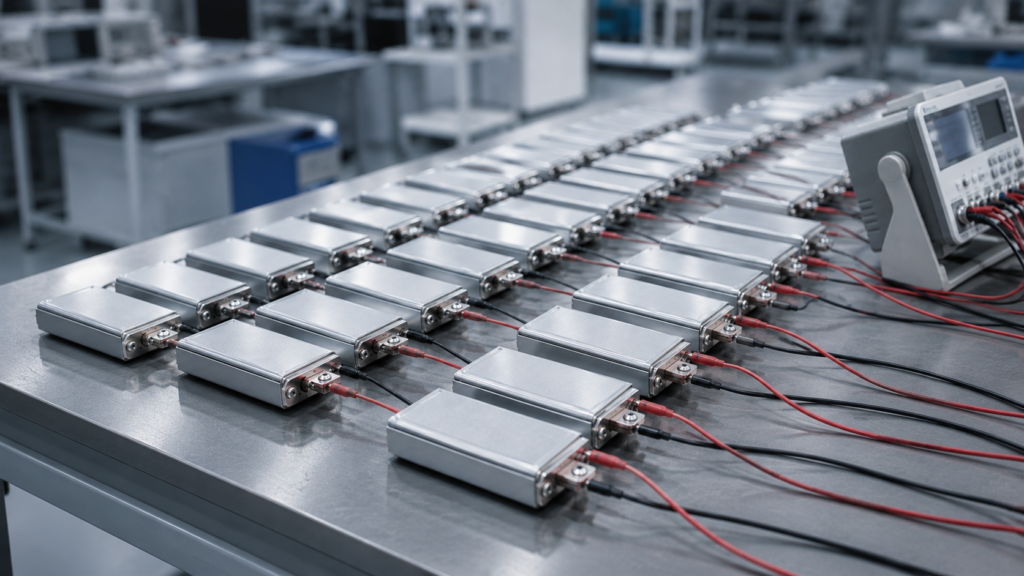
The pack is dismantled under controlled conditions rather than shredded. Modules are separated, cells are exposed, and each cell is tested individually — resting voltage, internal resistance, and capacity under a controlled charge and discharge cycle, plus physical inspection for swelling, venting, leakage and thermal damage.
Cells that meet the required standard are matched and set aside for a second life. Cells that don’t are sent on for recycling.
The output isn’t material. It’s a graded population of tested cells, with data behind each one.
The real difference: what gets assessed
Here’s the distinction that actually explains the outcome.
Recycling makes one decision about the whole pack. The pack is waste, so the pack gets processed.
Recovery makes a separate decision about every cell.
That matters because a retired pack is never uniform. A battery is retired when it stops meeting the requirements of its original application — a home battery that’s dropped to 70% of usable capacity can no longer run a household overnight, and that’s a legitimate reason to replace it. But the pack performs to the level of its weakest cells. One degraded module can retire a battery containing many cells that are still close to specification.
Send the whole pack to a shredder and every one of those cells is written off along with the failed ones. Assess at cell level and they’re separated, tested and kept in service.
|
Recycling |
Recovery |
|
|
Unit of decision |
The pack |
Each cell |
|
Core process |
Shredding and material separation |
Dismantling and diagnostic testing |
|
Output |
Raw materials |
Tested, graded cells |
|
What survives |
The materials |
The cell’s function |
|
Applies to |
Every battery, eventually |
Cells that pass testing |
Why recovery should come first
Three reasons, in order of how much they’ll matter to you.
- It’s irreversible in one direction only. A cell that has been recovered can still be recycled later, at the end of its second life. A cell that has been shredded can never be recovered. Assessment before shredding costs you nothing in options; shredding before assessment costs you all of them.
- Manufacturing a cell takes more than the materials in it. Mining, refining, cell manufacture and quality control all carry energy and emissions cost. Recycling recovers the materials but not that invested effort — the process has to be repeated. A reused cell carries its manufacturing footprint forward instead of paying it again.
- It’s what a circular economy actually requires. “Circular” is used loosely enough to be meaningless. In practice it means keeping things at their highest useful value for as long as possible, and only breaking them down when they can’t be used any other way. Material recovery is the floor of a circular system. Function recovery is the part that does the real work.
Where recycling is the right answer
Recovery isn’t always available, and pretending otherwise would be dishonest.
Recycling is the correct and only outcome for cells that have suffered internal damage or short circuit, that show swelling, venting or leakage, that have a thermal event in their history, that have degraded past the point of useful capacity, or that come from packs damaged by fire, flood or crushing.
There’s no assessment result that makes those cells safe to reuse. They go to approved recycling partners, where the material streams are handled properly.
This is why a provider who promises reuse for your specific battery before testing it is telling you something they can’t know. The honest position is that recovery is attempted, testing decides, and recycling handles the rest.
What this means if you have a battery to dispose of
Ask any provider one question: do you assess at cell level before anything is shredded?
If the answer is no, the entire pack is going to material recovery regardless of what’s inside it. That may still be a legitimate, compliant service — but you should know that’s what you’re buying.
If the answer is yes, ask what happens to the cells that fail. “Recovery only” isn’t a complete answer either. A responsible process covers both outcomes: cells that qualify go to a second life, cells that don’t go to approved recycling, nothing goes to general waste, and nothing sits stockpiled waiting for a market that may not arrive.
Both paths, documented, under one chain of custody. That’s what a complete end-of-life process looks like.
FAQ
They do different jobs and a complete process needs both. Recovery keeps working cells in service; recycling reclaims materials from cells that can't be reused. The sequence is what matters — assess first, then recycle what doesn't qualify.
No. Cells that are damaged, swollen, vented, deeply degraded, or that have a thermal event in their history are not suitable for reuse under any circumstances. They go to recycling.
A battery or cell that has been retired from its original application, tested, and redeployed into a less demanding one. A cell that no longer meets the requirements of a home energy system may still be well within specification for other uses.
Each cell is tested individually for resting voltage, internal resistance and actual capacity against its original rating, and inspected physically. Only cells that meet our standards across all of those measures are set aside for potential reuse.
Almost always, in part. A pack rarely produces all-pass or all-fail results. Cells that meet the standard are recovered; the remainder goes to approved recycling partners.
Find out what’s actually inside your retired battery
Every pack we collect is dismantled and tested at cell level before any decision is made. Submit a collection request and we’ll assess it properly.
LFP (LiFePO₄) and NMC batteries. Residential, commercial ESS and EV packs. CBD collection across Australia.