
No. You can’t put batteries in the bin in Australia — not the rubbish bin, not the recycling bin, not green waste. Every battery chemistry is excluded, from a single AA to a solar storage system, and the reason is fire: a battery that gets crushed in a waste truck or at a sorting facility can ignite.
Every battery has a disposal route that isn’t the bin. Small ones go to free drop-off points. Large ones are collected from your site. LFP Recovery Australia is a specialist collection and recovery service for end-of-life LFP and NMC batteries, operating across Australian capital city CBDs — and this page covers where every type should go, including the ones we don’t handle.
Can You Put Batteries in the Bin?
No, and this holds for every bin a household has.
Bin | Can batteries go in it? |
General rubbish / landfill bin | No |
Kerbside recycling bin | No |
Green waste / FOGO bin | No |
Council hard waste collection | No — generally excluded as hazardous |
Skip bin | No |
It also holds for every battery type: alkaline AAs, button cells, rechargeable NiMH, phone and laptop batteries, power tool packs, e-bike batteries, lead-acid car batteries, and large-format lithium home storage.
The single exception people reasonably ask about is a battery sealed inside a device, like a phone or a cordless toothbrush. That doesn’t belong in a kerbside bin either — the device goes to an e-waste drop-off point, where the battery is separated properly.
Why Do Batteries Start Fires in Bins?
Because waste systems crush everything, and a crushed lithium cell can enter thermal runaway.
Thermal runaway is a self-sustaining chain reaction: a damaged cell heats up, which damages it further, which generates more heat, until it ignites. It doesn’t need an external flame or spark. Once it starts in a compactor truck or a pile of sorted material, there’s fuel all around it.
The sequence that causes most of these fires is mundane:
- A battery goes into a kerbside bin with ordinary household waste.
- The bin is tipped into a collection truck with a compactor.
- The compactor punctures or crushes the cell.
- The cell short-circuits internally and begins heating.
- It ignites inside a sealed metal box full of paper, plastic and cardboard.
Battery-related fires in waste collection vehicles and recycling facilities are a recognised and growing problem across Australia. State environment regulators publish direct guidance on it — the <a href=”https://www.epa.nsw.gov.au/Your-environment/Recycling-and-reuse/never-bin-a-battery” rel=”nofollow” target=”_blank”>NSW EPA’s “never bin a battery” guidance</a> sets out the risk and what to do instead.
Smaller batteries are not safer. A single AA has less stored energy than a home battery, but a button cell wedged in a bale of cardboard has started facility fires. The risk comes from the combination of damage and surroundings, not from size alone.
Is Binning a Battery Illegal in Australia?
In most cases, yes — though the exact legal basis varies by state and territory.
Three separate things usually prohibit it:
- Council collection terms. Kerbside bin services set out what may and may not be placed in each bin, and batteries are excluded as hazardous or problem waste almost everywhere.
- State e-waste landfill bans. Several jurisdictions prohibit electronic waste, including batteries, from going to landfill at all.
- Waste classification. Batteries are commonly classified as hazardous or regulated waste, which brings separate handling obligations.
What that means in practice: the rules differ between states on the detail, but there is no state in Australia where putting a lithium battery in a kerbside bin is the correct thing to do. If you want the jurisdictional specifics for your own state, that’s worth checking with your state environment regulator or your council directly.
The safety reason holds regardless of what the local rule says. A battery that starts a fire in a truck has caused the same damage whether or not a regulation named it.
What Happens If Batteries Go to Landfill?
Two things, neither good: the materials are lost, and the hazards remain.
Materials are lost. A battery contains lithium, metals and other processed materials that took energy and mining to produce. In landfill, all of it is gone — and in the case of lithium batteries, some of those cells may still have had usable capacity before being buried.
The hazards stay. Battery casings degrade. Lead-acid batteries contain lead and sulfuric acid. Lithium cells that are damaged on their way into a landfill can ignite there, and landfill fires are notoriously difficult to extinguish once they establish underground.
This is the honest case for the alternative, and it’s not a complicated one: batteries are recoverable or recyclable through established routes, and those routes exist in every capital city.
Where Should Batteries Go Instead?
Depends on size and chemistry. Here’s the whole picture:
What you have | Where it goes | Cost |
AA, AAA, C, D, 9V, button cells | B-cycle drop-off point | Free |
Phone, laptop, tablet batteries | B-cycle drop-off point | Free |
Power tool, e-bike, e-scooter packs | B-cycle drop-off point | Free |
Device with a sealed-in battery | E-waste drop-off or council facility | Usually free |
Lead-acid, including car batteries | Auto recycler, battery retailer or scrap merchant | Often free or paid |
Home battery / solar storage (LFP or NMC) | Site collection by a specialist service | Quoted after assessment |
Commercial ESS, EV packs | Site collection by a specialist service | Quoted after assessment |
For everything in the first four rows, the <a href=”https://bcycle.com.au/about/battery-stewardship-council” rel=”nofollow” target=”_blank”>B-cycle battery stewardship scheme</a> lists participating drop-off locations — typically supermarkets, hardware stores, office supply retailers and council facilities. Free, no booking.
What About a Home Battery or Solar Battery?
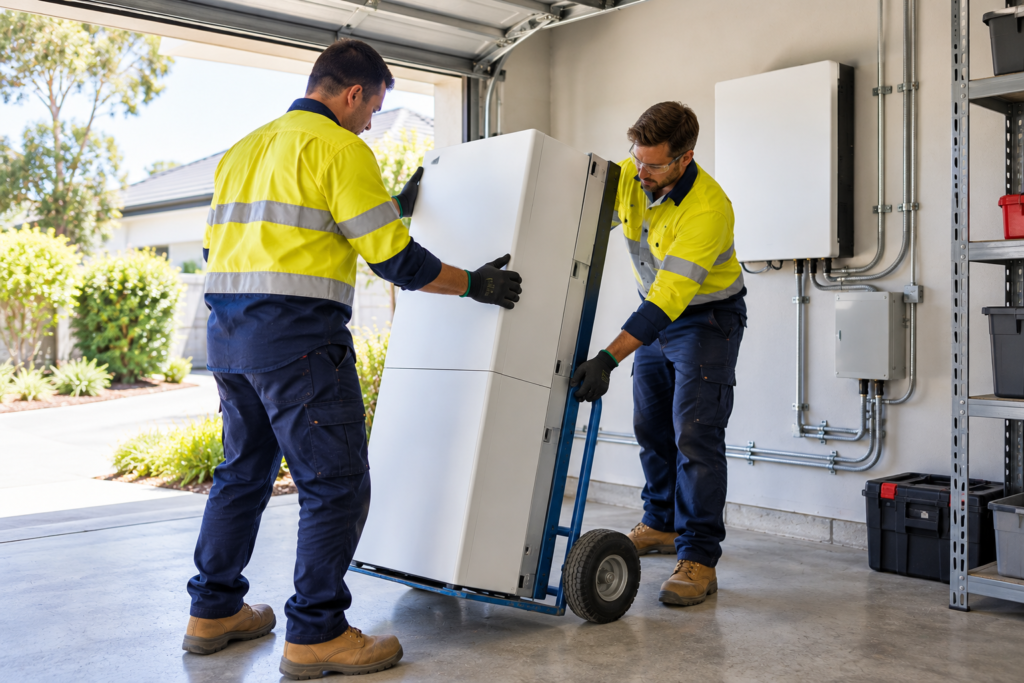
Those can’t be binned and can’t be dropped off either — they’re collected from your address.
A home energy storage unit is too heavy to hand over at a counter, holds residual charge, and moves as Class 9 dangerous goods for transport. Drop-off programs cap what they accept by size and format, and every large-format lithium pack falls outside that cap.
LFP is lithium iron phosphate, written LiFePO₄ — the chemistry most common in Australian home solar storage. NMC is lithium nickel manganese cobalt oxide, found in EV packs and some earlier home systems. We collect both.
When we collect a pack, it’s dismantled under controlled conditions and every cell tested individually for voltage, internal resistance and capacity. Cells that meet our testing standards may be recovered for potential reuse; cells that fail go to approved recycling partners under a documented chain of custody — a written record of who held the battery at each stage, from pickup to final outcome. Nothing is stockpiled and nothing goes to general waste.
Not every cell can be recovered. Damage, deep degradation and prior thermal events all rule cells out, and we won’t promise reuse for a specific battery before it’s been assessed. The distinction between battery recovery and battery recycling explains why testing comes first, and the full six-step collection and recovery process covers each stage.
We collect from capital city CBDs across Australia: Sydney, Melbourne, Brisbane, Perth, Adelaide, Hobart, Canberra and Darwin. Outside a capital city CBD? Submit a collection request and we’ll let you know if we can help — our operations team assesses outer-suburban, regional and remote pickups case-by-case.
Got a home battery or solar storage unit to get rid of? Submit a collection request with your battery details and we’ll assess what’s involved.
How to Store Batteries Safely Until You Can Dispose of Them
Most people collect batteries in a drawer for months before a trip to a drop-off point. That’s fine, with a few precautions.
For small batteries:
- Keep them in a non-metal container, somewhere cool and dry
- Tape the terminals of 9V and button cells — their contacts sit close enough to short against each other
- Don’t let loose cells rattle together in a pile
- Keep button cells well out of reach of children — they’re a recognised ingestion hazard
For a large battery awaiting collection:
- Keep it disconnected and isolated, ideally in a garage or detached structure rather than inside the house
- Keep it away from flammable materials and exits
- Don’t cover it, stack anything on it, or seal it in a container
- Never attempt to open, dismantle, discharge or transport a damaged lithium battery yourself
If any battery is swollen, leaking, deformed or hot, isolate it and declare the damage when you arrange disposal. If one is actively smoking, hissing or hot to the touch, leave the area and call 000.
The Short Version
No battery goes in any bin. Small ones go free to a drop-off point. Lead-acid goes to an auto recycler. Large-format lithium is collected from your site.
If you’ve got a home battery, solar storage system, commercial ESS or EV pack, that last one is us. Tell us the chemistry if you know it, the capacity, roughly how old it is, whether it’s still installed, and whether there’s any visible damage.
Further questions about chemistries, formats and what we accept are answered on our frequently asked questions and battery collection service page.
FAQ
No. Batteries are excluded from general rubbish, kerbside recycling, green waste and hard waste collections across Australia. Crushed or punctured cells can enter thermal runaway and ignite inside collection trucks and sorting facilities. Every battery type has an alternative route, and small batteries are free to drop off.
The recoverable materials are lost, and the hazards remain. Casings degrade over time, lead-acid batteries contain lead and sulfuric acid, and lithium cells damaged on the way in can ignite — landfill fires are extremely difficult to extinguish once established underground.
In most cases yes, though the legal basis varies by state. Council collection terms exclude batteries as hazardous waste, several states ban e-waste from landfill, and batteries are commonly classified as regulated waste. Check your state regulator or council for the specifics that apply to you.
Waste trucks and sorting facilities crush their contents. A crushed lithium cell short-circuits internally and begins heating, triggering thermal runaway — a self-sustaining reaction that needs no external spark. It then ignites surrounded by paper, cardboard and plastic. Small batteries cause these fires too.
Household and device batteries go free to a B-cycle drop-off point at participating supermarkets, hardware stores and council facilities. Lead-acid batteries go to auto recyclers or scrap merchants. Home batteries, solar storage, commercial ESS and EV packs are collected from your site by a specialist service.
Keep small batteries in a non-metal container somewhere cool and dry, tape the terminals of 9V and button cells, and keep button cells away from children. Keep a large battery disconnected, isolated, away from flammables, uncovered and never in a bin.
Need to Dispose of an Old or End-of-Life Lithium Battery?
Looking for a safe and responsible way to dispose of your old, damaged or end-of-life lithium battery? LFP Recovery Australia provides professional battery collection, assessment, recovery and recycling services for LFP (LiFePO₄) and NMC batteries, including solar battery storage systems, commercial energy storage batteries and electric vehicle (EV) battery packs.
Our team assesses each battery to identify opportunities for recovery and repurposing, while ensuring unsuitable cells are directed to responsible recycling. Whether your battery is damaged, no longer performing or ready for replacement, we’re here to help you take the next step.
Not sure what type of battery you have? Submit a collection request with photos and our team will review your details and advise on the next steps.