
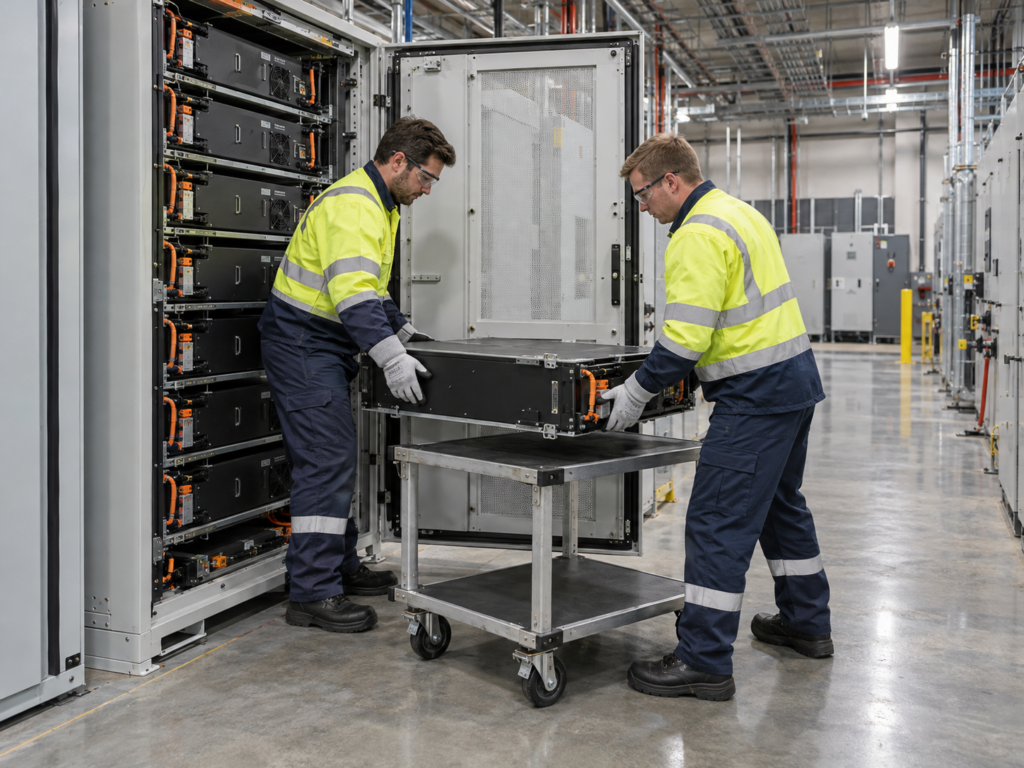
Commercial battery disposal comes down to four things a business has to arrange: safe isolation and de-energisation of the system, compliant transport of the modules, a documented chain of custody, and a verifiable record of where the material ended up. Miss any one of them and the obligation isn’t discharged, however the batteries physically leave site.
LFP Recovery Australia is a specialist collection and recovery service for end-of-life LFP and NMC batteries, operating across Australian capital city CBDs. We handle commercial ESS modules and racks, fleet and EV packs, and large residential systems. This page sets out what the process involves, what paperwork to expect, and what you’ll need to be able to show afterwards.
How Does a Business Dispose of Batteries?
Through a specialist collection service, with the system isolated before anything is moved. Commercial batteries aren’t a waste-contractor job and they aren’t a skip-bin job — the transport classification alone rules both out.
The four obligations, in order:
- Isolation and de-energisation. A commercial ESS is wired into switchboards, inverters and often a building management system. De-energising and disconnecting it is licensed electrical work, and in most cases needs to be documented as part of the decommissioning record.
- Compliant transport. Lithium batteries are carried as Class 9 dangerous goods under the <a href=”https://ntc.gov.au/codes-and-guidelines/australian-dangerous-goods-code” rel=”nofollow” target=”_blank”>Australian Dangerous Goods (ADG) Code</a>. That means compliant vehicles, compliant packaging, trained drivers and the right consignment documentation — not a general freight booking.
- Documented chain of custody. A chain of custody is a written record of who held the material at each stage, from the moment it leaves your site to its final outcome. For a business, this is the part that turns a removal into a discharged obligation.
- A verifiable final outcome. Somebody has to be able to tell you what actually happened to the material — not “it was recycled” as a category, but an account of where it went.
A business that can produce all four has a defensible position. A business that can only produce an invoice from whoever took the batteries away does not.
Is a Business Liable for Battery Waste?
Generally, yes — and the liability usually doesn’t end when the batteries leave the loading dock.
Australian waste frameworks commonly place a duty on the generator of the waste, not only on whoever transports or processes it. In practice that means the organisation that owned the battery system retains an interest in where the material goes, and is the party asked to account for it if anyone asks later.
The obligations that typically bear on a commercial battery disposal:
- Work health and safety duties around handling energised, damaged or thermally unstable equipment, and around the contractors brought on site to do it
- State and territory waste requirements, including classification of the material and any tracking obligations that attach to it
- Dangerous goods transport obligations under the ADG Code
- Environmental approvals or licence conditions that may apply to the site itself
- Internal governance — procurement, asset disposal and ESG or sustainability reporting requirements
Confirm your own position rather than relying on this page. Obligations vary by state, by industry and by the licence conditions attached to a particular site. Your WHS adviser and your state environment regulator are the right sources for what applies to you specifically — this article describes the general shape of the process, not legal advice.
What Documentation Is Needed for Commercial Battery Disposal?
More than most organisations expect, and the gaps usually show up at audit rather than at collection. What a complete file looks like:
Document | What it establishes | Who produces it |
Asset inventory | What was removed — chemistry, capacity, module count, serial or asset numbers | You, ideally before removal |
Condition report | State of each module, including any damage, swelling or thermal history | You and the collection service jointly |
Isolation and disconnection record | That de-energisation was performed by licensed personnel | Your electrical contractor |
Site risk assessment / SWMS | How the removal work was controlled | The party performing the removal |
Dangerous goods consignment documentation | That transport complied with the ADG Code | The transport provider |
Chain of custody record | Who held the material at each stage, from site to final outcome | The collection service |
Final outcome statement | What happened to the material — recovered, recycled, or otherwise | The collection service |
The two most commonly missing items are the first and the last. An asset inventory compiled before removal is far more accurate than one reconstructed afterwards, and a final outcome statement is the document that closes the loop — without it, the file stops at “collected by” and the question of where the material went stays open.
Scoping a decommissioning or disposal? Submit a collection request with the system details and site information, and our team will assess what’s involved.
How Is a Commercial ESS Decommissioned?
In sequence, with the assessment deliberately placed after collection rather than before:
- Scoping and site assessment — system details, module count, chemistry, condition, site access, lifting requirements and any constraints on working hours or loading.
- Isolation and de-energisation — performed by licensed electrical personnel and documented.
- Module removal and packaging — modules removed and packaged for transport, with damaged units identified and handled separately.
- Transport — compliant transport aligned with the ADG Code, as a Class 9 dangerous goods consignment.
- Cell-level assessment — each pack dismantled under controlled conditions, every cell tested for voltage, internal resistance and capacity.
- Recovery or recycling — cells meeting our testing standards recovered for potential reuse; cells that fail routed to approved recycling partners.
- Documentation — chain of custody record and final outcome statement provided.
Step five is where this differs from straight-to-shredder disposal. Cell-level diagnostics means judging each cell on its own measured performance rather than issuing a verdict on a whole rack based on its age or its label. In a commercial installation, modules that came out of the same cabinet on the same day are routinely in different condition, and a single whole-system verdict destroys whatever was still serviceable.
Site access usually drives the schedule more than the battery does. Basement plant rooms, no lift access, restricted loading windows and after-hours-only work all change the plan, which is why scoping comes first. The full collection and recovery process covers each stage in more detail.
Who Collects Commercial Battery Systems?
We do, for lithium chemistries. LFP is lithium iron phosphate, written LiFePO₄ — the dominant chemistry in commercial and residential storage. NMC is lithium nickel manganese cobalt oxide, found in EV and fleet packs and some earlier installations. We collect both.
What we take:
- Commercial ESS modules, racks and cabinets
- Residential and light-commercial energy storage systems
- EV and fleet battery packs and modules
- Damaged, swollen or thermally unstable lithium packs, where the condition is declared in advance
- Mixed-condition batches from a single site
What we don’t take: lead-acid, including UPS and stationary standby banks — those go to auto or industrial lead recyclers. Loose and small-format batteries are covered by the national product stewardship scheme, and the <a href=”https://www.epa.nsw.gov.au/Your-environment/Recycling-and-reuse/never-bin-a-battery” rel=”nofollow” target=”_blank”>NSW EPA’s battery disposal guidance</a> confirms what every regulator says about the one route that isn’t available to a business: landfill and general waste bins are not an option for any battery chemistry.
We collect from capital city CBDs across Australia: Sydney, Melbourne, Brisbane, Perth, Adelaide, Hobart, Canberra and Darwin. Outside a capital city CBD? Submit a collection request and we’ll let you know if we can help — our operations team assesses outer-suburban, regional and remote pickups case-by-case. Commercial sites outside CBD boundaries are common and assessed on the specifics.
Details of what’s included are on our battery collection service page, and our approach to standards alignment is set out on the about page.
What Happens to the Modules After Collection
Each pack is dismantled under controlled conditions and every cell tested individually. Cells that meet our testing standards may be recovered for potential reuse; cells that fail go to approved recycling partners. Nothing is stockpiled and nothing goes to general waste.
Not every cell can be recovered, and we won’t tell you otherwise before assessment. Physical damage, deep degradation and prior thermal events all rule cells out regardless of what they measure on the day. For a commercial batch this means the outcome is usually mixed — some modules yielding recoverable cells, others not — and the final outcome statement reports what actually happened rather than a projection.
That matters for anyone reporting on it internally. We can tell you what happened to your material under a documented chain of custody. We don’t publish recovery percentages or diversion rates, and we won’t invent them for a report — see the note at flag I5 if your organisation needs quantified figures.
Handling and transport are aligned with the ADG Code, relevant AS/NZS standards, state EPA waste requirements and WHS obligations. Commercial terms are set out in our terms and conditions.
What Does Commercial Battery Collection Cost?
Quoted case by case after assessment. For a commercial job the variables are mostly site variables rather than battery variables: module count and total mass, chemistry, condition, access and lifting requirements, working-hour restrictions, location relative to a capital city CBD, and whether de-installation is in scope.
We don’t publish a rate, because a rack-mounted system on a ground-floor dock and the same system in a basement with no lift access aren’t comparable jobs. Submit the system details and site information and we’ll come back by email with a figure that reflects the actual scope. We won’t quote a pickup date or turnaround upfront either — both depend on access, condition and location.
Arrange a Commercial Collection
If you’re decommissioning an ESS, replacing a fleet’s packs, or closing a site with batteries in it, the earlier the scoping happens the better — an asset inventory taken before removal is worth considerably more than one reconstructed afterwards.
Tell us the system details: chemistry if known, capacity, module count, approximate age, condition, whether it’s still installed and energised, and the site access situation. We’ll assess it and come back by email.
FAQ
Through a specialist lithium collection service, with the system isolated and de-energised by licensed personnel first. Commercial batteries move as Class 9 dangerous goods under the ADG Code, which rules out general waste contractors and skip bins. A documented chain of custody and final outcome statement complete the obligation.
Specialist lithium collection services. LFP Recovery Australia collects commercial ESS modules and racks, fleet and EV packs, and large residential systems from capital city CBDs, with case-by-case assessment outside them. Lead-acid banks, including UPS standby systems, go to industrial lead recyclers instead.
An asset inventory, a condition report, an isolation and disconnection record, a site risk assessment, dangerous goods consignment documentation, a chain of custody record, and a final outcome statement. The inventory and the outcome statement are the two most commonly missing, and the two most often asked for at audit.
Generally yes, and liability commonly doesn't end at the loading dock — Australian waste frameworks typically place duties on the generator of the waste. WHS duties, state waste requirements and ADG transport obligations all apply. Confirm your specific position with your WHS adviser and state regulator.
Scoping and site assessment, then isolation and de-energisation by licensed personnel, module removal and packaging, ADG-compliant transport, cell-level assessment, then recovery or recycling, with documentation issued at the end. Site access usually drives the schedule more than the battery itself does.
Quoted case by case after assessment. The variables are mostly site variables — module count and mass, condition, access and lifting requirements, working-hour restrictions, location, and whether de-installation is in scope. Submit the system and site details for a figure reflecting actual scope.
Need to Dispose of an Old or End-of-Life Lithium Battery?
Looking for a safe and responsible way to dispose of your old, damaged or end-of-life lithium battery? LFP Recovery Australia provides professional battery collection, assessment, recovery and recycling services for LFP (LiFePO₄) and NMC batteries, including solar battery storage systems, commercial energy storage batteries and electric vehicle (EV) battery packs.
Our team assesses each battery to identify opportunities for recovery and repurposing, while ensuring unsuitable cells are directed to responsible recycling. Whether your battery is damaged, no longer performing or ready for replacement, we’re here to help you take the next step.
Not sure what type of battery you have? Submit a collection request with photos and our team will review your details and advise on the next steps.