
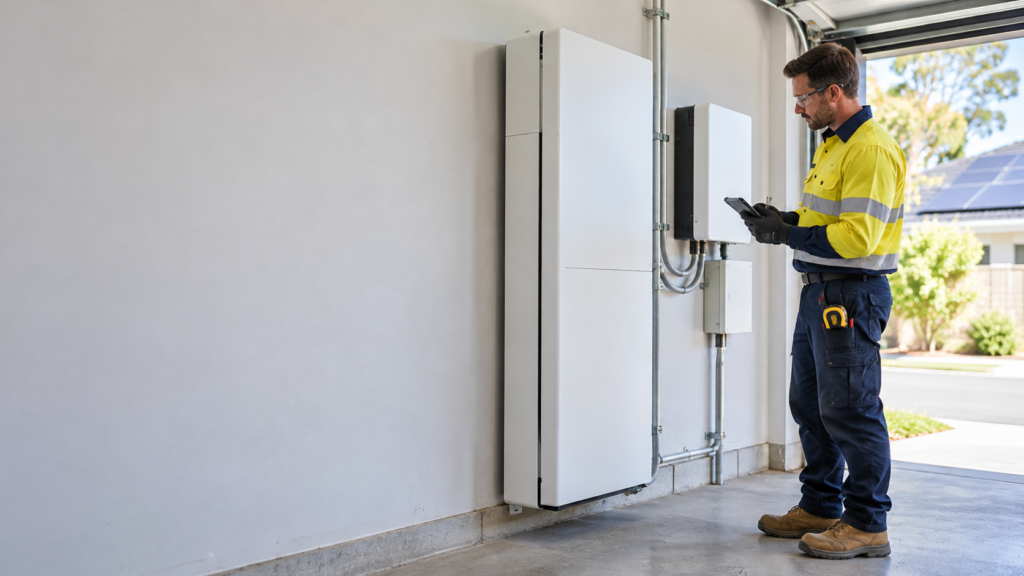
Battery disposal cost in Australia splits cleanly in two. Loose household batteries are free to dispose of — there’s a national drop-off network funded by a product stewardship scheme, and you pay nothing. Home batteries, solar storage systems, commercial ESS and EV packs are quoted case by case after assessment, because the work involved varies enormously from one battery to the next.
LFP Recovery Australia is a specialist collection and recovery service for end-of-life LFP and NMC batteries, operating across Australian capital city CBDs. This page explains what you’ll pay, what drives the figure, and why we assess before quoting rather than publishing a flat rate.
Is Battery Disposal Free in Australia?
For small batteries, yes — genuinely free, not free-with-conditions.
The B-cycle battery stewardship scheme funds free drop-off for loose and small-format batteries at participating supermarkets, hardware stores, office supply retailers and council facilities nationwide. That covers AA, AAA, C, D and 9V cells, button and coin cells, phone and laptop batteries, power tool packs, and e-bike and e-scooter batteries. No booking, no charge.
If that’s what you have, stop reading and use a drop-off point. You don’t need a collection service and you shouldn’t pay for one.
For large-format batteries, no. Home energy storage, solar battery systems, residential and commercial ESS and EV packs all fall outside that scheme, and collection is a quoted service. The reason isn’t that someone decided to charge for it — it’s that the work is different in kind.
Why Isn’t Large Battery Disposal Free?
Because a home battery requires trained handlers, dangerous goods transport, controlled dismantling and individual cell testing — and because, unlike household cells, there’s no stewardship levy funding any of it.
Here’s what sits behind the figure:
Trained handling. A retired home battery holds residual charge and is a multi-person lift, often needing equipment. That’s a skilled task, not a kerbside pickup.
Dangerous goods transport. Lithium batteries move as Class 9 dangerous goods under the Australian Dangerous Goods (ADG) Code. That means compliant vehicles, compliant packaging and trained drivers — a different cost base from a general waste run.
Controlled dismantling. The pack is taken apart under controlled conditions rather than tipped into a shredder.
Cell-level testing. Every cell is tested individually for voltage, internal resistance and capacity. This is the step that makes recovery possible, and it’s labour.
Downstream recycling. Cells that fail testing go to approved recycling partners, and that handling has its own cost.
The honest version: large battery disposal is a real industrial process, and somebody pays for it. Where disposal appears free, it’s either funded by a stewardship levy — as household batteries are — or by the scrap value of the material, as with lead-acid. Large-format lithium has neither.
What Drives the Battery Disposal Cost for Your Pack
Six factors, and they’re why two quotes for apparently similar batteries can differ substantially.
Factor | Why it changes the figure |
Battery type and chemistry | A home storage unit, a commercial ESS rack and an EV module are different jobs with different handling requirements |
Condition | Swollen, leaking or heat-damaged packs need additional precautions, packaging and handling time |
Still installed or already removed | A battery wired into an inverter and switchboard needs licensed de-installation first; one sitting disconnected does not |
Site access | Ground-floor garage with driveway access versus a basement with no lift, stairs or a narrow corridor |
Location | Within a capital city CBD versus outside one, which affects transport |
Quantity | A single unit versus several packs collected in one visit |
Which means two things worth knowing before you enquire. First, photos and site access notes genuinely change your quote — they’re not form-filling, they’re the information that determines the figure. Second, if your battery is straightforward (disconnected, undamaged, accessible, in a CBD), you’re at the easier end of the range.
Want a figure for your battery? Submit a collection request with photos and site access notes, and we’ll come back to you by email after assessment.
Why We Quote After Assessment Instead of Publishing a Rate
Because any single published rate would be wrong for most batteries.
Set it high enough to cover a damaged pack in a basement with no lift access, and it overcharges everyone with a disconnected unit in an accessible garage. Set it at the easy end, and it either collapses on contact with a difficult job or becomes a headline figure that rises once someone actually looks at the battery. Neither is a service we want to run.
So we assess first. You submit the form with battery details, photos and access notes; we work out what the job actually involves; we come back by email with a figure that reflects your situation. No obligation at that point, and no pricing before assessment.
We don’t quote a turnaround or a pickup date upfront either — both depend on location, access and battery condition. Commercial terms are set out in our terms and conditions.
How Pricing Fits Into the Collection Process
The quote comes after step one and before anything is collected:
- Collection request — you submit the online form with battery details, photos and site access notes.
- Assessment and quote — we review what’s involved and respond by email with a figure.
- Safe collection — once you’re happy to proceed, pickup is arranged with trained handlers.
- Transport — compliant transport aligned with the ADG Code, as a Class 9 consignment.
- Cell-level assessment — the pack is dismantled under controlled conditions and every cell tested.
- Recovery or recycling — cells that meet our testing standards are recovered for potential reuse; cells that fail go to approved recycling partners.
The full collection and recovery process has more detail on what happens after pickup.
What the Fee Actually Buys
Not just removal. The cost covers an assessed outcome and a documented one.
Cell-level diagnostics. Every cell judged on its own measured performance rather than a whole-pack verdict based on age or label. A pack described as “end of life” routinely contains cells still within reusable specification — cell-level diagnostics is how those get identified instead of destroyed.
A documented chain of custody. A written record of who held the battery at each stage, from pickup to final outcome. Nothing stockpiled, nothing to general waste.
An honest account of what happened. Not every cell can be recovered — physical damage, deep degradation and prior thermal events all rule cells out, and we won’t promise reuse for any specific battery before it’s been tested. What we will do is tell you the actual outcome.
For a homeowner the practical value is simpler than any of that: the battery is gone, it went somewhere legitimate, and you can say where.
What’s included in collection is set out on our battery collection service page, and the frequently asked questions cover pricing, de-installation and damaged packs in more detail.
Where We Collect
We collect from capital city CBDs across Australia: Sydney, Melbourne, Brisbane, Perth, Adelaide, Hobart, Canberra and Darwin.
Outside a capital city CBD? Submit a collection request and we’ll let you know if we can help — our operations team assesses outer-suburban, regional and remote pickups case-by-case. Location affects transport and therefore cost, which is one reason the quote comes after we’ve seen your address.
Get a Figure for Your Battery
If you have a retired home battery, solar storage system or EV pack, the cost depends on your specific situation — and the fastest way to find out is to tell us about it.
Submit the form with chemistry if you know it, capacity, approximate age, whether it’s still installed, any visible damage, photos, and a note on site access. We’ll assess it and come back by email with what’s involved.
FAQ
For loose and small-format batteries, yes — the B-cycle stewardship scheme funds free drop-off at participating retailers and council facilities nationwide. For home batteries, solar storage, commercial ESS and EV packs, no: those fall outside the scheme and collection is quoted case by case after assessment.
It's quoted after assessment rather than published as a rate, because the work varies significantly. The figure depends on battery type and chemistry, condition, whether it's still installed, site access, location and quantity. Submit a collection request with photos and you'll receive a figure by email.
Large-format lithium batteries need trained handlers, Class 9 dangerous goods transport, controlled dismantling and individual cell testing, and no stewardship levy funds any of it. Household batteries are free because a scheme pays for them; lead-acid is often free because of scrap value. Large lithium has neither.
Yes, for large-format batteries — quoted case by case after assessment. We don't charge for the assessment itself, and there's no obligation once you receive the figure. Loose household batteries shouldn't come to us at all; those go to a free B-cycle drop-off point.
Six factors drive the figure: battery type and chemistry, condition, whether it's still installed, site access, location relative to a capital city CBD, and how many packs are being collected. Photos and site access notes submitted with your request materially affect the quote.
That's precisely why we assess before quoting rather than after. The figure we send follows a review of your battery details, photos and access notes — so the more accurate the information you provide, the more reliable the quote. Undeclared damage or access problems are what cause revisions.
Arrange Collection Instead
If you came here looking for somewhere to drop a battery off, the short version is: small batteries have a free drop-off network, and large ones get collected from your address. Both are legitimate routes. Only one of them fits a home battery.
Tell us what you’ve got — chemistry if you know it, capacity, approximate age, whether it’s still installed, and whether there’s any visible damage.