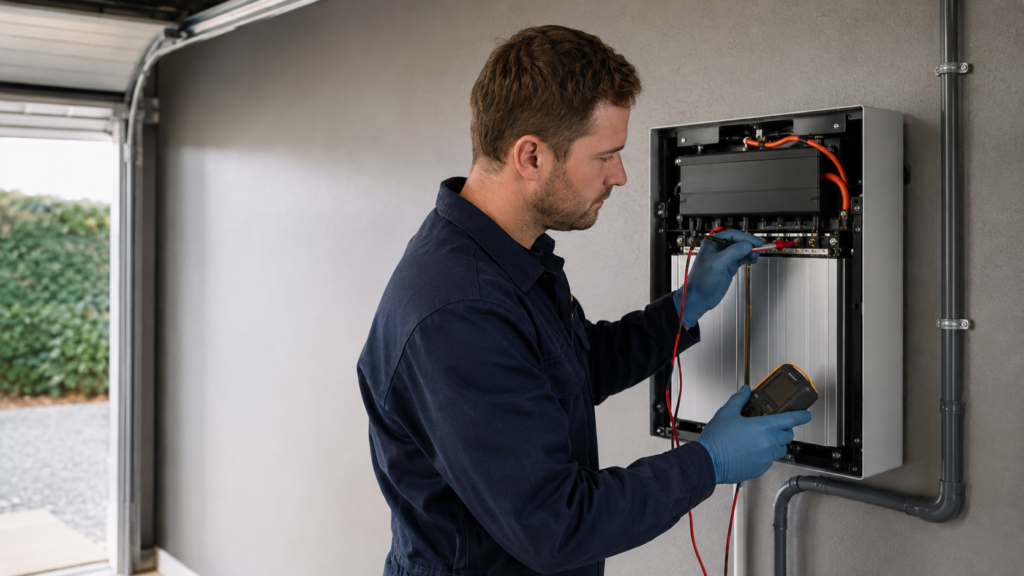
Your home battery has stopped holding charge the way it used to. Or your installer has told you the system is past its service life. Or you’re decommissioning a commercial ESS and someone has asked where the batteries are going.
The next question is always the same: what actually happens to it?
Here’s the full path a retired lithium iron phosphate (LFP / LiFePO₄) battery takes, from the moment it comes off your wall to its documented final outcome — and what you can reasonably expect at each stage.
First: “end of life” doesn’t mean the battery is dead
This is the most useful thing to understand before anything else.
A battery reaches end of life when it no longer meets the requirements of the job it was bought for. A home battery that has dropped to 70% of its original usable capacity is no longer good enough to run a household overnight. That’s a real reason to replace it. It is not the same as the cells inside being finished.
A retired pack is a mixed population. Some cells will have degraded badly. Some will sit close to their original specification. Some will have failed outright. The pack performs to the level of its weakest cells, which means one poor module can retire a battery full of cells that still have years of useful service in a less demanding application.
That gap — between the pack’s rating and the condition of the individual cells — is the entire reason recovery exists as a step before recycling.
Stage 1: Collection request and assessment
Everything starts with information. Before a vehicle is dispatched, we need to know what we’re collecting: chemistry, manufacturer and model, approximate capacity, age, whether the unit is still installed, and critically, whether there’s any visible damage.
Photos matter more than people expect. A swollen casing, a bulging module, corrosion around terminals, or evidence of heat all change how the battery is handled, what equipment comes to site, and in some cases whether it can be moved at all without additional controls.
This is also where serviceability is confirmed. We collect from capital city CBDs. If you’re outside a CBD, submit the request anyway — outer-suburban, regional and remote pickups are assessed case by case rather than declined automatically.
Stage 2: Safe collection from site
Trained handlers attend, isolate and remove the battery, and prepare it for transport.
A retired lithium battery is not inert. Even a pack showing low state of charge holds stored energy, and damaged or thermally unstable units carry real risk. This is why the handling step is done by people trained for it, with appropriate personal protective equipment and containment, rather than by a general waste crew with a trolley.
If the battery is still wired into a system, de-installation by a licensed electrician is usually required first. Tell us in the form whether the unit is still installed and we’ll advise on what needs to happen before collection day.
Stage 3: Transport under the ADG Code
Lithium batteries are classified as Class 9 dangerous goods. Moving them on Australian roads sits under the Australian Dangerous Goods (ADG) Code, which sets requirements for packaging, segregation, labelling, documentation and vehicle handling.
Our collection and transport processes are aligned with the ADG Code and with relevant AS/NZS standards for battery handling and workplace safety.
This is not a formality. It’s the reason a retired battery can’t go in the back of a ute, into a skip bin, or out with the household waste — and it’s the stage where most informal disposal arrangements quietly fail.
Documentation begins here. From pickup, the battery moves under a documented chain of custody, so its location and status are tracked to its final outcome.
Stage 4: Dismantling under controlled conditions
At the facility, the pack is dismantled in a controlled environment — enclosure removed, modules separated, wiring harness and battery management system taken out, and cells exposed for individual assessment.
This is skilled work. High-voltage packs remain energised. Modules are heavy, sometimes adhesive-bonded, and manufacturers rarely design them with disassembly in mind. Dismantling is the step that most operators skip, because it’s slow and the alternative — feeding the whole pack into a shredder — is faster and cheaper.
Skipping it is also the step that destroys every recoverable cell in the pack.
Stage 5: Cell-level diagnostics
Every cell is then tested individually. We look at three things:
- Voltage — resting voltage and how the cell behaves under load. Cells sitting well below their expected range indicate internal problems.
- Internal resistance — resistance rises as a cell ages. It’s one of the clearest indicators of degradation and of a cell’s ability to deliver current reliably.
- Capacity — the cell is charged and discharged under controlled conditions to establish how much energy it actually holds against its original rating.
Cells are also inspected physically for swelling, venting, leakage, terminal corrosion and thermal damage. A cell that tests acceptably on paper but shows physical damage does not proceed.
Two batteries of the same brand, same age and same nameplate rating can produce completely different results here. Duty cycle, depth of discharge, thermal history and installation environment all leave a mark on the cells that a label never shows. This is why an assessment can’t be done from a photo, and why nobody can honestly tell you what will happen to your battery before it’s been tested.
Stage 6: The decision — recovery or recycling
Each cell then goes one of two ways.
Cells that meet our standards are set aside for potential reuse. Matched by capacity and internal resistance, they can go on to second-life applications through pack builders, engineers and R&D teams. Every cell reused is one that doesn’t need to be manufactured from newly mined lithium, iron, phosphate or graphite.
Cells that fail testing go to approved recycling partners, where the material streams are processed properly and the constituent materials re-enter the supply chain.
Nothing goes to general waste. Nothing is stockpiled indefinitely waiting for a market.
We won’t tell you in advance which outcome your battery will have, because we don’t know until it’s tested. What we will tell you is what actually happened to it.
What you should expect to receive
A defensible end-of-life process should give you:
- Confirmation of collection, with the battery identified
- Chain-of-custody documentation tracking the unit from pickup to outcome
- A statement of the final outcome — what was recovered, what was recycled
For a homeowner, this is peace of mind. For a business, it’s the evidence you need for your own compliance, insurance and environmental reporting obligations. If you’re decommissioning commercial assets and can’t produce a record of where the batteries went, that’s a gap somebody will eventually ask you about.
What not to do with a retired lithium battery
Briefly, because it matters:
- Don’t put it in kerbside bins — general waste or recycling. Damaged lithium cells are a documented cause of fires in waste collection vehicles and processing facilities.
- Don’t put it in a skip.
- Don’t store it indefinitely in a garage, shed or plant room, particularly if it’s damaged or swollen. Time and heat don’t improve a degraded cell.
- Don’t attempt to open the pack yourself. High voltage, stored energy, and a real risk of internal short circuit.
- Don’t drop it at a general battery drop-off point. Those are set up for loose handheld batteries, not wall-mounted energy storage systems.
The short version
Collection request → safe collection → ADG-compliant transport → controlled dismantling → cell-level testing → recovery of cells that qualify, responsible recycling of those that don’t.
Six steps, one documented outcome, and an honest answer at the end about what happened to your battery.
FAQ
The usual signs are reduced usable capacity, faster discharge than when it was new, error codes or faults reported by the battery management system, or advice from your installer that the system is past its service life. Physical signs — swelling, heat, unusual noise or smell — mean the battery should be treated as damaged and reported when you submit a collection request.
Not necessarily. Tell us in the collection request form whether the battery is still installed. If de-installation is required, we'll advise on what needs to happen and who needs to do it.
Note it clearly in the form and include photos. We're set up to handle damaged and thermally unstable packs, but we need to know before we arrive so the right handling controls and equipment are in place.
We can't promise that. Whether any cell is suitable for a second life depends entirely on how it performs under testing. Cells that meet our standards are recovered for reuse; cells that don't are sent to approved recycling partners. We'll tell you honestly what happened.
LFP (lithium iron phosphate / LiFePO₄) as our primary specialty, and NMC (lithium nickel manganese cobalt oxide). This covers residential batteries, commercial ESS and EV packs.
Have a battery that’s reached end of life?
Submit a collection request with your battery details. We’ll confirm serviceability, arrange safe collection, and give you a documented outcome — not a vague promise.