
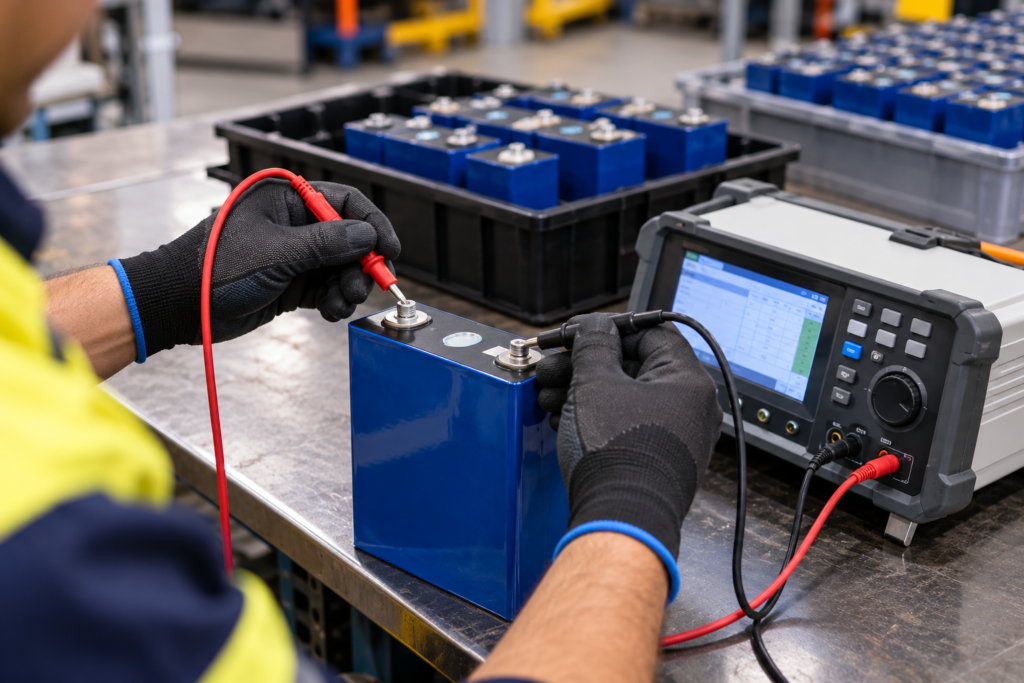
Your battery is transported under dangerous goods conditions to a controlled facility, sorted by chemistry and condition, dismantled, and then tested cell by cell. Cells that meet our testing standards are set aside for potential reuse. Cells that fail go to approved recycling partners. Every stage is recorded, and we can tell you what happened to your specific battery.
That’s the short answer to what happens to collected batteries. The longer answer is worth reading if you’re weighing up handing one over, because “it gets recycled” is where most providers stop explaining — and the gap between that phrase and a documented outcome is where batteries get stockpiled, mishandled or quietly written off.
LFP Recovery Australia is a specialist collection and recovery service for end-of-life LFP and NMC batteries, operating across Australian capital city CBDs.
What Happens to Batteries After Collection?
Six stages, in order, with the testing deliberately placed before any decision about recycling.
- Collection — the battery is picked up from your site by trained handlers.
- Transport — carried as Class 9 dangerous goods under the <a href=”https://ntc.gov.au/codes-and-guidelines/australian-dangerous-goods-code” rel=”nofollow” target=”_blank”>Australian Dangerous Goods (ADG) Code</a>, in compliant packaging and vehicles.
- Receipt and sorting — logged in, identified by chemistry and format, and separated by condition.
- Controlled dismantling — the pack is opened under controlled conditions and broken down to module and cell level.
- Cell-level assessment — every cell tested individually for voltage, internal resistance and capacity.
- Outcome — cells meeting our testing standards set aside for potential reuse; cells that fail routed to approved recycling partners.
Each handover is recorded. The six-step collection and recovery process sets out the operational detail behind each stage.
How Are Batteries Sorted for Recycling?
Sorting happens twice — once at pack level on receipt, and again at cell level after testing. The two are different jobs.
At pack level, on arrival, batteries are separated by:
- Chemistry — LFP (lithium iron phosphate, written LiFePO₄) and NMC (lithium nickel manganese cobalt oxide) take different downstream routes, so they don’t mix
- Format — home storage units, commercial ESS modules and EV packs dismantle differently
- Condition — damaged, swollen or thermally suspect packs are segregated immediately and handled separately from intact units
That last one is why declaring damage on the collection form matters. A swollen pack arriving undeclared gets handled as though it were intact until someone notices, which is the one scenario everyone involved wants to avoid.
At cell level, after testing, cells are sorted by measured performance into those suitable for potential reuse and those bound for material recycling. That’s the sort that actually determines your battery’s outcome.
How Are Battery Cells Tested?
Three measurements per cell, each answering a different question.
Measurement | What it tells us |
Voltage | Whether the cell is holding charge at all, and whether it sits within acceptable range against its siblings in the pack |
Internal resistance | How efficiently the cell can deliver current — rising resistance is one of the clearest indicators of age and wear |
Capacity | How much energy the cell actually stores now, against what it stored when new |
Together these establish a cell’s state of health — its remaining usable capacity compared with when it was new.
Why every cell, rather than a sample. A pack-level reading is an average, and averages conceal the thing that matters. Two cells from the same pack, installed on the same day in the same climate, routinely measure differently. A pack reporting a low overall figure can contain cells well above it, and a pack reporting an acceptable average can contain individual cells that have failed.
Cell-level diagnostics means judging each cell on its own measured performance rather than issuing one verdict for the whole unit. It’s slower than a whole-pack assessment, and it’s the only way to find the cells worth keeping. More on how that feeds into reuse decisions is on our battery recovery and repurposing page.
Thinking about handing a battery over? Submit a collection request with the details and we’ll assess what’s involved.
What Is Chain of Custody for Battery Waste?
Chain of custody is a written record of who held the material at each stage, from the moment it leaves your site to its final outcome. It’s the difference between knowing your battery was collected and knowing what became of it.
What the record tracks:
- What was collected, and from where
- Its condition on receipt
- Each transfer of custody along the way
- The assessment result
- The final outcome for the material
For a homeowner, this is reassurance. For a business, it’s the document that turns a removal into a discharged obligation — which is why commercial customers ask for it by name and householders usually don’t realise they can.
Either way, the record exists because the alternative is a provider who cannot tell you what happened. That’s not a hypothetical failure mode in this industry; it’s the normal one.
Are Collected Batteries Stockpiled?
No. Nothing is stockpiled and nothing goes to general waste.
Stockpiling is the specific failure this industry is known for: batteries accumulated in a warehouse because processing them costs more than collecting them, sometimes for years, occasionally until something catches fire. It happens because collection is easy and recovery is not.
Our position is that every battery collected goes through assessment and reaches a documented outcome. That’s a commitment about process rather than a claim about speed — we don’t publish turnaround times, because they depend on volume, condition and what the assessment finds. What we do commit to is that the material moves through the process rather than sitting at the front of it.
What We Can and Can’t Tell You
This is worth being direct about, because the honest answer has two halves.
What we will tell you: what happened to your battery. The chain of custody record covers your specific collection, and if you want to know the outcome — how many cells were recovered, what went to recycling — ask and we’ll tell you from the record.
What we don’t publish:
- The names of our recycling partners. Commercial arrangements, and not ours to disclose publicly.
- Recovery percentages or diversion rates. We don’t publish aggregate figures, and we won’t generate one for a report. Your battery’s outcome is specific to your battery.
- Guaranteed outcomes in advance. We can’t tell you what proportion of your cells will be recoverable before they’ve been tested, because nobody honestly can.
What we can’t promise at all: that your pack will yield reusable cells. Physical damage, deep degradation and prior thermal events all rule cells out regardless of what they measure on the day. Some packs come back with very little worth recovering, and we’d rather say that plainly now than imply otherwise and disappoint later.
If what you actually want to know is where the material physically ends up, that’s a fair question and the answer for your battery is in your record. Ask us.
What You Get Afterwards
A documented account rather than a disposal receipt.
- Confirmation of collection — what was collected and when
- The assessment outcome — what the cell testing found
- The final outcome — what happened to the recovered cells and what went to recycling
- Chain of custody record — the full handover trail, available on request
For most householders, the practical value is simpler than any of that: the battery is gone, it went somewhere legitimate, and you can say where. For a business, it’s a file that stands up when someone asks.
Handling and transport are aligned with the ADG Code, relevant AS/NZS standards, state EPA waste requirements and WHS obligations. The <a href=”https://www.epa.nsw.gov.au/Your-environment/Recycling-and-reuse/never-bin-a-battery” rel=”nofollow” target=”_blank”>NSW EPA’s battery disposal guidance</a> sets out why the one route that isn’t available to anyone — landfill or general waste — is off the table. More on our standards position is on the about page, and there’s further detail on what happens to an end-of-life LFP battery.
Where We Collect
We collect from capital city CBDs across Australia: Sydney, Melbourne, Brisbane, Perth, Adelaide, Hobart, Canberra and Darwin.
Outside a capital city CBD? Submit a collection request and we’ll let you know if we can help — our operations team assesses outer-suburban, regional and remote pickups case-by-case.
Collection is quoted case by case after assessment, based on battery type, condition, whether it’s still installed, site access and location.
Ask Us What Happened to Yours
If the thing holding you back is not knowing where a battery ends up, that’s the right question to be asking, and it’s the one most providers answer with a single word.
Tell us what you’ve got — chemistry if you know it, capacity, approximate age, whether it’s still installed, and whether there’s any visible damage. You’ll get an assessment, a figure, and afterwards an account of what actually happened to it.
FAQ
They're transported as Class 9 dangerous goods, logged in and sorted by chemistry, format and condition, then dismantled under controlled conditions. Every cell is tested individually for voltage, internal resistance and capacity. Cells meeting testing standards may be recovered for reuse; cells that fail go to approved recycling partners.
Twice. At pack level on arrival, by chemistry, format and condition — damaged or swollen packs are segregated immediately. Then at cell level after testing, by measured performance, into cells suitable for potential reuse and cells bound for material recycling. The second sort determines the actual outcome.
No. Nothing is stockpiled and nothing goes to general waste. Every battery collected goes through assessment to a documented outcome. We don't publish turnaround times, since they depend on volume, condition and assessment findings — but the material moves through the process rather than accumulating at the front of it.
A written record of who held the material at each stage, from your site to its final outcome. It tracks what was collected, its condition on receipt, each transfer of custody, the assessment result and the final outcome. Available on request, and the document businesses need for compliance files.
Three measurements per cell: voltage, showing whether it holds charge and sits in range; internal resistance, showing how efficiently it delivers current and indicating wear; and capacity, showing how much it stores now against when new. Together these establish the cell's state of health.
Yes. The chain of custody record covers your specific collection, and we'll tell you the outcome — what was recovered and what went to recycling. We don't publish our recycling partners' names or aggregate recovery percentages, but your battery's own outcome is yours to ask for.
Need to Dispose of an Old or End-of-Life Lithium Battery?
Looking for a safe and responsible way to dispose of your old, damaged or end-of-life lithium battery? LFP Recovery Australia provides professional battery collection, assessment, recovery and recycling services for LFP (LiFePO₄) and NMC batteries, including solar battery storage systems, commercial energy storage batteries and electric vehicle (EV) battery packs.
Our team assesses each battery to identify opportunities for recovery and repurposing, while ensuring unsuitable cells are directed to responsible recycling. Whether your battery is damaged, no longer performing or ready for replacement, we’re here to help you take the next step.
Not sure what type of battery you have? Submit a collection request with photos and our team will review your details and advise on the next steps.