
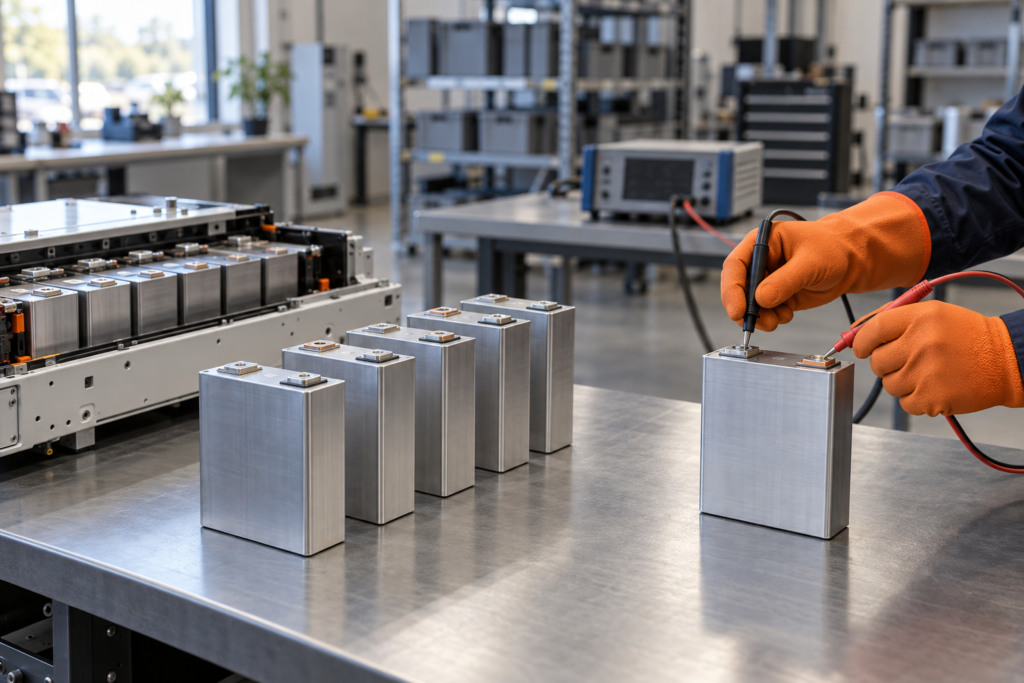
LFP battery recycling in Australia starts with testing, not shredding. A retired lithium iron phosphate battery is collected, dismantled under controlled conditions, and every cell is tested individually — because a pack labelled “end of life” routinely contains cells still within reusable specification. Cells that pass may be recovered for a second life; cells that fail go to approved recycling partners. LFP Recovery Australia is a specialist collection and recovery service for end-of-life LFP and NMC batteries, operating across Australian capital city CBDs.
The order matters more with LFP than with any other lithium chemistry, and the reason is in the chemistry itself.
What Does LiFePO₄ Stand For?
LFP stands for lithium iron phosphate, written chemically as LiFePO₄. It’s a lithium battery chemistry built from lithium, iron and phosphate — and notably, it contains no cobalt and no nickel.
It has become the default chemistry for home solar storage in Australia for two practical reasons: it’s thermally more stable than cobalt-based chemistries, and it tolerates a high number of charge cycles before capacity falls away. If you have a home battery installed in the last several years, LFP is the most likely chemistry inside it.
The other chemistry you’ll encounter is NMC — lithium nickel manganese cobalt oxide. NMC is energy-dense and compact, which is why it dominates EV packs and appears in some earlier home systems. It contains both cobalt and nickel. We collect both chemistries, with LFP as our primary specialty.
Is LFP Battery Recycling Different From Lithium-Ion Recycling?
Yes. “Lithium-ion recycling” is a category, not a process, and LFP sits at one end of it with a materially different economic picture from NMC.
|
LFP (LiFePO₄) |
NMC |
|
|
Full name |
Lithium iron phosphate |
Lithium nickel manganese cobalt oxide |
|
Key elements |
Lithium, iron, phosphate |
Lithium, nickel, manganese, cobalt |
|
Contains cobalt? |
No |
Yes |
|
Contains nickel? |
No |
Yes |
|
Typical use in Australia |
Home and commercial solar storage |
EV packs, some earlier home systems |
|
Thermal characteristics |
More thermally stable |
Higher energy density |
|
Collected by us? |
Yes — primary specialty |
Yes |
The consequence for recycling is straightforward. Conventional lithium-ion recycling economics are built largely around recovering cobalt and nickel — the two most valuable metals in a typical EV-era battery. An LFP cell contains neither.
That makes the case for testing before shredding stronger, not weaker. If a pack is shredded, what comes back from an LFP cell is a less valuable material stream than it would be from NMC. But a working LFP cell — one that still holds capacity, still has acceptable internal resistance — has value as a cell. Shredding it destroys that value and replaces it with something worth considerably less.
This is the engineering argument behind our process, and it’s why we don’t send whole packs straight to a shredder.
What Is an LFP Battery Recovered For If It Has No Cobalt?
For the cells themselves. An LFP cell that passes testing can go on to a second life — continued use in another application, rather than being broken down for materials.
The test that decides this is state of health: a measure of a cell’s remaining usable capacity compared with when it was new. A cell at reduced state of health isn’t finished, it’s just no longer suited to the duty cycle it came out of. Applications with gentler demands can still use it.
Which brings up the distinction that causes the most confusion in this industry:
- Recovery keeps the cell intact and in use. The cell stays a cell.
- Recycling breaks the cell down to reclaim its constituent materials. The cell stops being a cell.
Both are legitimate end-of-life outcomes, and both are necessary — but they aren’t interchangeable, and a provider who uses the words as synonyms is telling you something about their process. The difference between battery recovery and battery recycling is worth understanding before you hand a battery to anyone.
Where cells are recovered, they’re assessed and graded for suitability rather than passed on wholesale. Our battery recovery and repurposing service covers what that involves.
Have a retired LFP battery? Submit a collection request with your battery details and we’ll assess what’s involved.
How an LFP Battery Is Recycled, Step by Step
The sequence runs from your site to a documented final outcome, with the testing stage placed deliberately before any decision about recycling.
- Collection request — you submit the online form with battery details, photos and site access notes.
- Safe collection — pickup is arranged from your site with trained handlers.
- Transport — compliant transport aligned with the <a href=”https://ntc.gov.au/codes-and-guidelines/australian-dangerous-goods-code” rel=”nofollow” target=”_blank”>Australian Dangerous Goods (ADG) Code</a>, under which lithium batteries are carried as Class 9 dangerous goods.
- Cell-level assessment — the pack is dismantled under controlled conditions and every cell tested for voltage, internal resistance and capacity.
- Battery recovery — cells that meet our testing standards are recovered for potential reuse.
- Responsible recycling — cells that fail testing go to approved recycling partners.
Step four is where the real work happens. Cell-level diagnostics means judging each cell on its own measured performance rather than issuing a verdict on the whole pack based on its age or its label. Two LFP batteries installed in the same year, in the same climate, can be in very different condition inside — and within a single pack, individual cells often differ substantially from each other.
The whole process is tracked under a documented chain of custody: a written record of who held the battery at each stage, from pickup to final outcome. Nothing is stockpiled and nothing goes to general waste. You can see the full six-step collection and recovery process in more detail, including what happens between dismantling and the final decision.
Can Every LFP Cell Be Recovered or Recycled?
No, and it’s worth being plain about that.
Several things rule a cell out of recovery. Physical damage — crushing, puncture, deformation. Deep degradation, where capacity has fallen too far to be useful in any application. Thermal history: a cell that has previously overheated or been through thermal runaway, the self-sustaining chain reaction where a damaged lithium cell heats uncontrollably and can ignite, is not a reuse candidate regardless of what it measures today.
Those cells go to recycling rather than recovery. And recycling itself has limits — no process reclaims every material in a battery, and we don’t claim otherwise.
What we can tell you is what happened to your specific battery. That’s the point of the chain of custody: not a promise about the outcome, but a documented account of it. We can’t tell you in advance that your pack will be reused, because nobody honestly can before it’s been tested. There’s more detail on what happens to an end-of-life LFP battery through the full process.
What This Means If You Have an LFP Battery
If you have a retired LFP or NMC battery — a home storage unit, a residential or commercial ESS, or an EV pack — it needs collection from your site. It can’t go in a bin, can’t go to landfill, and is too large and too hazardous for a drop-off point.
What we collect, and what belongs elsewhere:
|
Battery type |
Do we collect it? |
If not, where should it go? |
|
Home battery / residential ESS (LFP or NMC) |
Yes |
— |
|
Solar battery storage systems |
Yes |
— |
|
Commercial ESS modules and racks |
Yes |
— |
|
EV battery packs and modules |
Yes |
— |
|
Swollen, leaking or heat-damaged lithium packs |
Yes — declare it on the form |
— |
|
Loose household batteries (AA, AAA, button) |
No |
B-cycle drop-off point |
|
Power tool, e-bike and small device batteries |
No |
B-cycle drop-off point |
|
Lead-acid batteries, including car batteries |
No |
Auto recycler or scrap metal merchant |
Loose household and small device batteries are covered by a national product stewardship scheme — the <a href=”https://bcycle.com.au/about/battery-stewardship-council” rel=”nofollow” target=”_blank”>B-cycle battery stewardship scheme</a> lists drop-off points across Australia. Lead-acid has its own well-established recycling route through auto recyclers and scrap metal merchants. We handle large-format lithium packs, which is a different job requiring different equipment.
We collect from capital city CBDs across Australia: Sydney, Melbourne, Brisbane, Perth, Adelaide, Hobart, Canberra and Darwin. Outside a capital city CBD? Submit a collection request and we’ll let you know if we can help — our operations team assesses outer-suburban, regional and remote pickups case-by-case.
Details of what we accept and how pickup is arranged are on our battery collection service page.
FAQ
An LFP battery is collected, transported under ADG-compliant conditions, then dismantled so every cell can be tested for voltage, internal resistance and capacity. Cells meeting testing standards may be recovered for reuse; cells that fail are routed to approved recycling partners under a documented chain of custody.
Yes. LiFePO₄ cells can be recycled to reclaim their constituent materials, though recycling is generally the second step. Cells are tested first, because a pack described as end-of-life often contains cells still within reusable specification. No recycling process reclaims every material in a battery.
Yes. LFP contains no cobalt or nickel, the two metals that carry most of the value in conventional lithium-ion recycling. That makes testing cells before shredding more important with LFP, not less — a working cell is worth considerably more intact than as reclaimed material.
For the cells themselves. An LFP cell that passes testing can go on to a second life — continued use in another application rather than being broken down. Recovery keeps the cell intact and in use; recycling breaks it down to reclaim materials. Both are legitimate outcomes.
LiFePO₄ is the chemical formula for lithium iron phosphate, commonly abbreviated to LFP. It's built from lithium, iron and phosphate, and contains no cobalt or nickel. It's the most common chemistry in Australian home solar storage because it's thermally stable and tolerates many charge cycles.
No. Physical damage, deep capacity degradation and prior thermal events all rule a cell out of reuse, regardless of what it measures. Those cells go to approved recycling partners instead. We can't promise reuse for any specific battery before it has been assessed at cell level.
Arrange Collection for Your LFP Battery
An LFP pack that’s been replaced or taken out of service shouldn’t sit in a garage indefinitely, and it shouldn’t go to a shredder without being assessed first. Those are the two bad outcomes, and both are avoidable.
Tell us what you’ve got — chemistry if you know it, capacity, approximate age, whether it’s still installed, and whether there’s any visible damage. Collection is quoted case by case after assessment, and we’ll come back to you by email with what’s involved.