
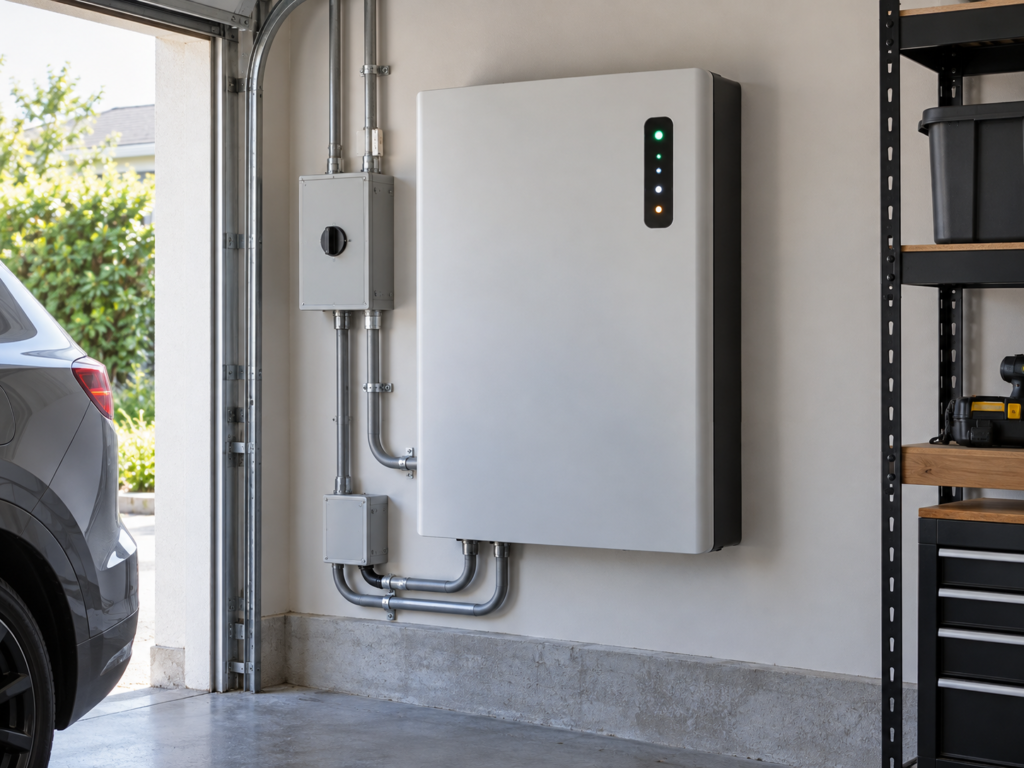
How long home batteries last depends on the chemistry, how hard the system has been cycled, the climate it sits in, and what the manufacturer specified in the first place — and the honest answer for your battery is written in your own warranty documentation rather than in a general article.
Home battery warranties are normally expressed two ways at once: a term in years, and a capacity retention figure — the proportion of original usable capacity the manufacturer guarantees will remain at the end of that term. Those two numbers together are the manufacturer’s own statement of expected life, and they vary meaningfully between products. Find them before you take anyone’s general figure, including ours.
LFP Recovery Australia is a specialist collection and recovery service for end-of-life LFP and NMC batteries, operating across Australian capital city CBDs. We see retired packs after they come off the wall, which gives us a particular view of this question: a great many batteries arrive labelled “end of life” with cells inside that are still within reusable specification.
How Long Does a Home Battery Last?
Longer than most people expect, and the answer is specified rather than estimated.
Where to find your battery’s actual figures:
- The warranty certificate issued at installation — the term and the capacity retention figure both live here
- The compliance label on the unit itself, which carries chemistry and capacity
- The installer’s handover documentation
- The manufacturer’s product datasheet for your specific model
If you can’t find any of those, your installer can usually retrieve them from the installation record.
What those figures actually mean. A warranty that guarantees a stated capacity retention at the end of a stated term is not a promise the battery stops working at that point. It’s a floor, not a cliff. A battery past its warranty term with capacity below the guaranteed level usually still stores and delivers energy — just less of it than it did when new.
LFP — lithium iron phosphate, written LiFePO₄ — is the chemistry in most Australian home storage, and it was chosen for this application partly because it tolerates a high number of charge cycles. NMC — lithium nickel manganese cobalt oxide — appears in EV packs and some earlier home systems. The two degrade differently, which is another reason a single generic figure is less useful than the one on your paperwork.
The <a href=”https://cleanenergycouncil.org.au/” rel=”nofollow” target=”_blank”>Clean Energy Council</a> publishes consumer guidance on home battery systems and approved installer information if you need an independent starting point.
What Is Battery State of Health?
State of health is a measure of a battery’s remaining usable capacity compared with when it was new, usually expressed as a percentage. A battery at reduced state of health hasn’t failed — it holds less than it used to.
This is the number that actually matters at end of life, and it’s the number a whole-pack verdict gets wrong. State of health measured at the pack level is an average. Inside that average, individual cells differ: some have degraded faster, some barely at all. A pack reporting a low overall figure can contain cells performing well above it.
That gap between the pack average and the individual cells is the entire basis of cell-level diagnostics — testing each cell on its own measured voltage, internal resistance and capacity rather than issuing one verdict for the whole unit.
What Shortens a Home Battery’s Life?
Five things, most of which are determined by how the system was specified and installed rather than anything you do day to day.
Factor | Effect |
Depth of discharge | Routinely running a battery to very low charge ages it faster than shallower cycling |
Cycling frequency | A system cycled hard every day accumulates wear faster than one cycled lightly |
Operating temperature | Heat is the main environmental factor; an uncooled garage in a hot climate is harder on a battery than a shaded, ventilated space |
Charge and discharge rate | Consistently high rates generate more heat and more wear than moderate ones |
Long periods at full or empty | Sitting at extremes of charge is harder on lithium cells than resting mid-range |
What this means practically: most of the above was locked in at installation — where the unit went, how it was sized against your usage, and how the inverter was configured. If your battery is underperforming earlier than expected, the installation is worth reviewing before the battery is condemned.
How Do I Know If My Solar Battery Is Failing?
Four categories of sign, in ascending order of urgency.
What you notice | What it usually means | What to do |
Noticeably less stored energy than it used to hold; running out overnight when it didn’t before | Normal capacity degradation, or a configuration change | Check your monitoring app’s capacity or state-of-health reading; compare against the warranty figure |
Error codes, fault warnings or alerts in the app or on the inverter | A system fault, which may be the battery, the inverter or the communication between them | Have your installer or an accredited electrician diagnose it — not every fault is the battery |
The unit running hot, fans running constantly, or unusual noise | A cooling, load or internal issue | Stop relying on it and have it inspected promptly |
Swelling, deformation, leaking, a burning smell, or heat you can feel through the case | Cell-level failure | Isolate it, keep it away from flammables, and arrange specialist collection. Do not open, dismantle, discharge or move it yourself |
The last row is different in kind from the other three. Those signs indicate a cell that has failed internally, and the risk is thermal runaway — a self-sustaining chain reaction where a damaged lithium cell heats uncontrollably and can ignite. The <a href=”https://www.accc.gov.au/system/files/Lithium-ion%20Batteries%20report_3_0.pdf” rel=”nofollow” target=”_blank”>ACCC’s report on lithium-ion battery safety</a> covers the consumer risks in detail.
If a battery is actively smoking, hissing, swelling or hot to the touch, leave the area and call 000.
Battery showing signs it’s finished? Submit a collection request with the details and photos, and our team will assess what’s involved.
Can a Degraded Battery Be Repaired?
Capacity loss can’t be reversed. Some faults that look like capacity loss can be fixed.
Those are two different situations and they’re worth separating before you accept that a battery is finished:
Potentially fixable by your installer: firmware and battery management system issues, inverter configuration or communication faults, incorrect charge limits, and sizing or setup problems that were never right. These present as poor performance and aren’t degradation at all.
Not fixable: actual cell degradation. Lithium cells lose capacity through physical and chemical change inside the cell, and no service, reconditioning or firmware update reverses it. Any offer to “recondition” or “rejuvenate” a home lithium battery deserves scepticism.
Never attempt repair yourself. A home battery is a high-energy, high-voltage system, and opening a pack is dangerous even when it’s behaving normally. Diagnosis goes to your installer or an accredited electrician; a failed pack goes to specialist collection.
When Should a Home Battery Be Replaced?
When what it still delivers no longer covers what you need from it — which is a usage question, not purely a technical one.
Worth weighing:
- How far below your needs it now falls. A battery at reduced capacity that still covers your evening load may have years of useful service left.
- Whether a fault has been ruled out. Diagnose before replacing; not all underperformance is degradation.
- Warranty position. If it’s inside the term and below the guaranteed retention figure, that’s a warranty conversation with the manufacturer or installer first.
- Any safety signs. Swelling, heat or damage move this from an economic decision to an immediate one.
If the answer is replacement, two things happen at once: a new battery goes in, and an old one comes out that has to go somewhere. Those are usually different conversations with different people, and the second one is easy to leave unresolved — which is how packs end up sitting in garages for months.
A Degraded Pack Isn’t a Dead Pack
A battery at the end of its service life in your house is not necessarily at the end of its useful life as a set of cells.
This is what we see when retired packs come in. The pack-level state of health reading that prompted the replacement is an average, and underneath it sit cells in genuinely different condition. Dismantled and tested individually, a proportion routinely measure within reusable specification.
Those cells may go on to a second life — continued use in another application rather than being broken down for materials. Cells that fail testing go to approved recycling partners under a documented chain of custody: a written record of who held the battery at each stage, from pickup to final outcome.
We won’t promise that your pack will yield reusable cells. Damage, deep degradation and prior thermal events all rule cells out, and some packs come back with very little worth recovering. Nobody can honestly say before testing. What we will do is tell you what actually happened to yours — and there’s more on what happens to an end-of-life LFP battery through the full process, plus detail on battery recovery and repurposing and the six-step collection and recovery process.
What to Do With a Retired Home Battery
It’s collected from your address. A home battery can’t go in a bin, can’t go to landfill, and is too large and too hazardous for a drop-off point.
We collect from capital city CBDs across Australia: Sydney, Melbourne, Brisbane, Perth, Adelaide, Hobart, Canberra and Darwin. Outside a capital city CBD? Submit a collection request and we’ll let you know if we can help — our operations team assesses outer-suburban, regional and remote pickups case-by-case.
Collection is quoted case by case after assessment, based on battery type, condition, whether it’s still installed, site access and location. What’s included is on our battery collection service page.
Working Out Where Yours Stands
Start with your warranty certificate — the term and the capacity retention figure are the only numbers specific to your battery. Then check your monitoring app for a current state-of-health reading. If the two don’t reconcile, or if you’re seeing faults, get it diagnosed before you accept that it’s finished.
And if it is finished, tell us what you’ve got: chemistry if you know it, capacity, approximate age, whether it’s still installed, and whether there’s any visible damage or swelling.
FAQ
It depends on chemistry, cycling, climate and the product itself — and your warranty states the manufacturer's own expectation as a term in years plus a capacity retention figure. Check the warranty certificate from installation, the compliance label, or your installer's handover documentation for the figures specific to your battery.
Four signs, escalating: noticeably less stored energy than before, error codes or faults in the app or inverter, the unit running hot or noisy, and — most seriously — swelling, deformation, leaking or a burning smell. The last indicates cell failure and needs isolation and specialist collection, not inspection.
State of health measures remaining usable capacity against the battery's original capacity, usually as a percentage. A reduced figure means it holds less than when new, not that it has failed. It's a pack-level average, so individual cells inside can be in considerably better condition than the number suggests.
Capacity loss can't be reversed — lithium cells degrade through physical change inside the cell. But faults that resemble degradation can often be fixed: firmware and battery management issues, inverter configuration and communication faults. Have an installer diagnose it before replacing. Never attempt repair yourself.
When its remaining capacity no longer covers what you need, and once a fault has been ruled out as the cause. If it's still inside the warranty term and below the guaranteed retention figure, raise it with the manufacturer or installer first. Safety signs make it immediate rather than economic.
It's collected from your site, dismantled under controlled conditions, and every cell tested individually for voltage, internal resistance and capacity. Cells meeting testing standards may be recovered for reuse; cells that fail go to approved recycling partners under a documented chain of custody.
Need to Dispose of an Old or End-of-Life Lithium Battery?
Looking for a safe and responsible way to dispose of your old, damaged or end-of-life lithium battery? LFP Recovery Australia provides professional battery collection, assessment, recovery and recycling services for LFP (LiFePO₄) and NMC batteries, including solar battery storage systems, commercial energy storage batteries and electric vehicle (EV) battery packs.
Our team assesses each battery to identify opportunities for recovery and repurposing, while ensuring unsuitable cells are directed to responsible recycling. Whether your battery is damaged, no longer performing or ready for replacement, we’re here to help you take the next step.
Not sure what type of battery you have? Submit a collection request with photos and our team will review your details and advise on the next steps.